What Is AI Slop? Why All AI Content Sounds the Same (And How to Stop Making It) (2026)
 Luke Shankula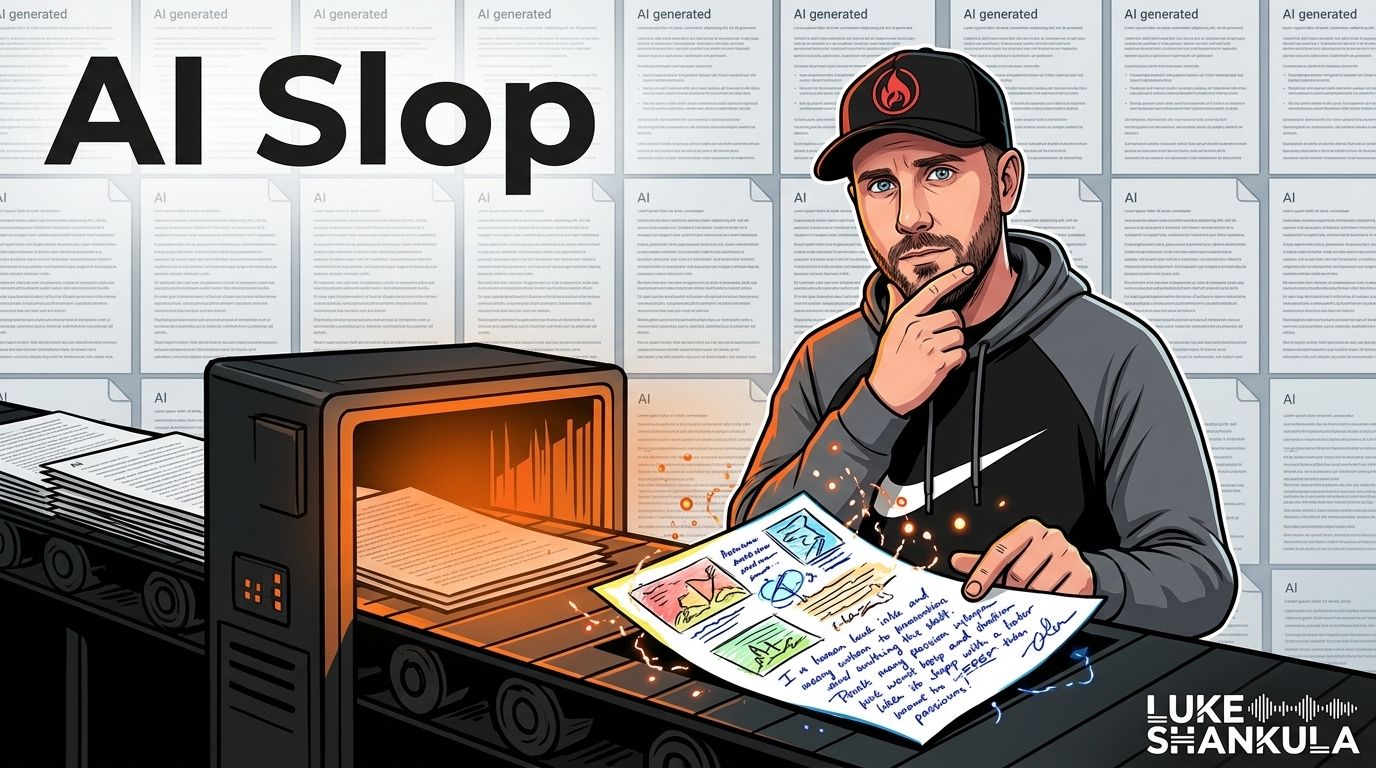
So there's a name for it now. People call it AI slop. Searches for that exact phrase are up over 500% year over year, with 33,100 people typing "ai slop" into Google every month as of early 2026. That number tells you what's happening. People can see what their feeds look like, and they finally have a word for it.
AI slop is the generic, low-effort, all-sounds-the-same content that fills every feed, inbox, and search result right now. Most of it gets produced the same way. Someone opens ChatGPT or Claude. They type a generic prompt. They copy the output. They paste it. They hit publish.
That workflow is the problem, and there's a way to fix it. I'm going to walk through what AI slop actually is, the four mechanics that produce it, how to recognize it in your own work, and how to build the second brain that fixes it at the root.
What is AI slop?
AI slop is the generic, low-effort content AI tools produce when you use them with generic prompts and no editing on the output. The thing that makes it slop is that it all sounds the same. AI slop reads like every other piece of AI slop because the model underneath has settled into a small set of default patterns, and most users never push it past those defaults.
The term started showing up around 2024 and spread everywhere through 2025 as feeds, news sites, and search results filled up with content that all sounded the same. Related searches like "ai garbage" and "ai is trash" are climbing alongside it. People are looking for a word to describe what they're already seeing everywhere.
Here's the simplest way I can define it. If you can read three paragraphs of a piece and tell it was AI-written without any other clues, that piece is AI slop. The issue isn't that AI was involved. The issue is that nobody put their voice on top of the output before publishing.
Why does AI content all sound the same?
Four mechanics are doing the work here, and understanding them changes how you use these tools.
All the models read the same stuff
Every major language model is trained on overlapping sources. Common Crawl, Wikipedia, Reddit, books, news archives. They have all read most of the same writing. When you give any of them a generic prompt like "write a LinkedIn post about productivity," they all reach for the same patterns because those patterns scored well across their training data. Different models, similar output. This is just language models doing what they were built to do.
Human raters trained the model to be polite
The second layer is reinforcement learning from human feedback, usually called RLHF. After the base model is trained, human raters score its outputs and the model learns to chase whatever scores well. Raters tend to score the same way. They reward clarity, structure, positive tone, hedged claims, balanced perspective. The model learns to produce content that hits those targets every time. The result is hollow opening hooks, perfectly balanced paragraphs, and conclusions that gently affirm whatever the user prompted. Anthropic and other labs have published research on this. The short version is that the more RLHF a model gets, the more it sounds like a polite assistant, and the more all of its output starts to sound the same.
Everyone is using the same prompts
This is the part nobody talks about. Most people who use AI for content use the same prompts. They got the prompts from the same Twitter threads, the same YouTube tutorials, the same listicles about "10 ChatGPT prompts for marketers." So even though the model underneath is capable of huge variation in output, the inputs are all landing in the same place. Same prompt plus same model produces same output. The AI tutorial industry built the slop problem more than the models did.
The model has a default voice you never override
This one is the easiest to fix and the one almost everyone ignores. The model has a default voice. If you don't tell it to use something else, it'll use that default voice every time. The default is whatever scored well in RLHF: balanced, clear, structured, slightly formal, vaguely optimistic. If you write in your actual voice and your actual voice sounds nothing like that default, the model will still produce the default unless you make it produce something else. Most people don't realize the assistant voice is the absence of a voice. It's a flat baseline that exists because no specific person fed the model instructions for something better.
How do you recognize AI slop?
There are about ten signatures. If you see three or more in the same piece, it was probably produced with minimal effort on top of a generic prompt.
- Em dashes everywhere. AI models love em dashes. Real writers vary their punctuation.
- The "It's not just X, it's Y" cadence. Same family as "It's not about X. It's about Y." Both are AI tells.
- Triple parallel constructions with abstract nouns. "Faster, smarter, better." "Build, ship, iterate." Three rhythm beats that carry almost no information.
- Hollow opener hooks. "In today's fast-paced world." "In the current landscape of." "Artificial intelligence has revolutionized." Filler that says nothing.
- Hedged claims. "Some experts suggest that..." "Many would argue..." Used to soften any actual opinion until there's no opinion left.
- The reveal pattern. "Here's the key insight." "The bottom line is." Setup phrases that promise something the next sentence rarely delivers.
- Vague future-facing closing CTA. "Embrace this technology." "The future is here." Exhortations that commit to nothing.
- Bulleted lists where prose would be better. AI defaults to lists because lists scored well in training. Real writing flows.
- The "let's break it down" or "let's unpack" transition. Phrases that exist to fill structure rather than carry meaning.
- Same vocabulary across totally different topics. The same model used for a finance post and a fitness post will reach for the same five or six go-to words in both. You can keep a running list of them. The words show up so often you start spotting them before you finish the sentence.
These signatures are easy to recognize because they show up in everyone's AI output. Once you know what to look for, you start seeing them on every LinkedIn post, every blog header, every newsletter. The internet now has a thick layer of AI text on top of it that all reads the same way, and that layer is what people mean when they say "AI slop."
What actually works instead?
The fix for AI slop is structural. You have to put something between the model and your output that makes the output sound like a specific human. There are three levels of doing this, ranked from cheapest to most durable.
Level 1: Edit aggressively
The lowest-effort fix is taking AI output and editing the AI tells out before you publish. Strip the em dashes. Rewrite the "It's not just X, it's Y" sentences. Cut the hollow openers. Replace the generic transitions with how you actually talk. I do this work on every piece of content that touches my name, and it takes about as long as writing the thing from scratch would have taken. Aggressive editing works for one-off posts. It doesn't scale because every piece of content needs the same manual labor, and most people who start editing this way eventually stop because the edit phase feels harder than just writing the thing themselves.
Level 2: Use voice prompts
The next step up is teaching the model your voice in the prompt every time. Paste three real examples of your writing into the conversation, then ask the model to write the new piece in that voice. This is better than nothing. The problem is the voice context fades over a long conversation. The model still reaches for its defaults the second you stop reminding it. And you have to redo the voice prompt every single time. Every new conversation, every new tool, every new model release means rebuilding the same voice instructions from scratch.
Level 3: Build a second brain for your voice
The durable fix is what I call building a second brain. You take a tool that lets you save context permanently. Claude Projects are by far the best tool for this work. They're built for exactly this use case, with the context window to actually hold a real voice guide and the writing quality to use it well. ChatGPT custom GPTs are a fallback if you're already in the ChatGPT world. The Claude option is what I run, what I teach, and what most of the people inside Direct Authority AI use. You load three things into that second brain once. From then on, every conversation starts with your voice already in place.
The three things you load are:
A written voice guide. This is a document that describes how you actually talk and write: what words you use, what words you avoid, the opinions you hold, the typical pace of your sentences, the way you open and close posts. Most people skip this step or do a one-line version of it ("write in a conversational tone"). Spend a real hour on it and write it like an actual specification. The more specific the document, the less the model has to guess.
A banned-words list. This is your personal "AI words to avoid" list. Mine has over 200 banned words and phrases on it now. Stuff AI loves to overuse. "Leverage." "Delve." "Navigate." "Robust." "Seamless." "Elevate." "Unlock." Also full phrases like "It's not just X, it's Y" and "let's break it down." The list grows every time I catch a new one in my drafts. Load it into the second brain with one instruction: never use any of these. Whenever you catch a new one in the wild, add it. The list is part of the brain forever.
Real examples of you. Five to ten pieces of writing or transcribed speech that sound the most like you. The ones where a friend reads it and says "yeah, that sounds like you." That material is the seed. The model uses it as the reference for everything it produces against the brain.
Set up once, the brain produces in your voice every time without you reminding it. You stop pasting "remember to write in my voice" into every conversation. The voice is the default state of the tool.
The hard part is that most people can't describe their own voice well enough to write the voice guide. Asking yourself "what makes my writing sound like me" is harder than it looks. That's the problem I built Duplico to solve. Duplico runs a guided voice interview, pulls out your pacing, your word choices, and the opinions you hold, then turns the interview into a real voice guide that drops into a Claude Project as the default. You can build the same thing manually if you've got the time, but Duplico runs the interview for you.
The core belief behind all of this: your humanness is your moat. In a world where everyone has access to the same AI models, the only real advantage left is sounding like a specific person instead of every other AI-assisted writer on the internet. The second brain is what protects that moat. Without it, you're just running a smarter ChatGPT.
The principle is what matters here, but the tool you use does too. Build your second brain inside a Claude Project. That's where Duplico drops in, that's what I run, and that's what the people inside Direct Authority AI run. ChatGPT custom GPTs are a fallback if you're already living in ChatGPT, but the output is not in the same league. The inputs are the same wherever you build it. Voice guide. Banned-words list. Real examples of you. If you don't put those three things between the model and your output, the output won't be specific to anyone.
What does AI content that isn't slop actually look like?
Three properties.
It sounds like a specific person. You can read it and form a sense of who wrote it. You pick up on their pacing, the kinds of words they reach for, the opinions they hold. The piece feels like the opposite of "this could have been written by anyone."
It takes a side. AI slop is full of "many would argue" and "it depends on your situation." Real content has a position. The writer cares about something specific and the reader can tell exactly what that thing is.
It earns the words it uses. AI slop is full of big-sounding words doing no real work. "Robust framework." "Strategic approach." "Innovative solution." Those words are stickers, glued on top of the content to make it sound smart. Real content uses specific words that paint a picture. "The $9,800 I put on my wife's credit card in 2017." "Growing up at a missionary school in Ecuador where most of the kids did not look like me." "The agency I built, scaled, hated, and burned down." You can see those. The stickers are interchangeable. The specifics are not.
When a piece has all three of those properties, it's hard to mistake for AI slop even when AI helped produce it. Slop is a voice problem, not an AI problem. Any piece of content has a voice or it doesn't. AI just makes it faster to publish whichever you decided on.
Is AI slop getting worse or better?
It's getting worse, and fast. Three reasons.
Searches for "ai slop" grew over 511% year over year. Once people have a word for something, they can sort against it. The more they recognize AI slop, the less it works.
Models keep getting better at the polite-assistant voice with every round of RLHF training. The better they get at sounding like the assistant, the more obvious that voice gets when it shows up in your feed.
Detection is catching up with production. Tools like Originality.ai and GPTZero now flag AI content with high accuracy. Search engines and ad networks are pushing low-effort AI content down in the rankings. The SEO penalty for slop is going to grow.
There's also a knock-on effect coming. The next round of models will be trained partly on the slop the current models produced. Researchers call this model collapse. The output gets blander each round, and the real human writing left in training data gets more valuable, not less.
The conclusion is simple. The people who win with AI from here forward are the ones who have a real voice underneath the tool. Everyone else is just making slop faster.
How can I make sure my AI content does not sound like slop?
Five practical moves anyone can make this week.
- Write your voice guide. Sit down for an hour and document how you actually talk and write. The words you use. The words you avoid. The opinions you hold. How you open a post. How you close one. The more specific you can be, the less your AI tool has to guess.
- Build your AI-words-to-avoid list. Start a running list of the words and phrases AI defaults to when you write with it. Mine has over 200 on it now and keeps growing. Stuff AI loves to overuse. "Leverage." "Delve." "Navigate." "Robust." "Seamless." Plus phrases like "It's not just X, it's Y." Add to it every time you catch a new one. Then load the list into your AI tool with one instruction: never use any of these.
- Set up a second brain. Build it inside a Claude Project. That's the best tool for this work and it's not close. ChatGPT custom GPTs work as a fallback if you're already in that world. Drop in the voice guide, the words-to-avoid list, and 5 to 10 real examples of your writing. From then on, every conversation starts with your voice loaded as the default state of the tool.
- Read your output before you publish it. Read the draft out loud. If it doesn't sound like you, AI's writing it. Rewrite the parts that sound like AI until they sound like you.
- Take an opinion. AI defaults to balance. Real writing has a side. If you can't tell what you actually think about a topic, the AI can't either, and the output reads as empty because it is.
The bigger move underneath all five is this. Stop thinking about AI as a content generator. AI is a multiplier on top of whatever voice you already have. Without a voice, AI can't help you. With one, AI can put that voice in front of a lot more people than you ever could on your own.
Want to see voice-first AI in practice?
I built Duplico for exactly this. Guided voice interview, drops the result into your Claude Project as the default. The deeper write-up of the full approach lives at Direct Authority AI, the coaching community where this gets taught end to end. If you've been watching your AI output sound like every other AI-assisted post on your feed, that's where to start.
Frequently Asked Questions
What is the difference between AI slop and AI-assisted writing?
AI-assisted writing is writing where AI participated in the production process and the final output still sounds like a specific human. AI slop is writing where AI produced most of the output and nobody put a voice on top of it before publishing. The tools used are identical in both cases. What changes is whether anyone added a real voice on top.
Can AI detect AI slop?
Yes, and the detection is getting better fast. Tools like Originality.ai and GPTZero can spot AI-generated content with high accuracy. Search engines have started weighting their algorithms against low-effort AI content. Over the long term, the back-and-forth between detection tools and AI output favors real human writing.
Does using ChatGPT or Claude automatically produce slop?
No. Using them with a generic prompt and zero post-processing produces slop. Using them with a voice-trained foundation and editing your output produces content that benefits from AI speed without sounding like AI.
Is AI slop the same thing as AI hallucination?
No. Hallucination is when AI makes up facts. Slop is when AI produces generic, low-effort content that all sounds the same. A piece can be factually accurate and still be slop if it sounds like every other AI-written piece on the internet.
Will AI content always sound like AI?
Only if you let it. The default behaviors that create slop are the easiest path for the user, which is why they're so common. The fix is structural. Capture your voice, load it into your tools, and the output starts sounding like you instead of like the assistant.
What is a "second brain" and how does it stop AI slop?
A second brain is a place you load your voice context into once and reuse across every AI conversation. Build it inside a Claude Project. That's the best tool for this work and it's not close. ChatGPT custom GPTs are a fallback. You upload three things: a voice guide that describes how you talk, a list of AI words you don't use, and 5 to 10 real examples of your writing. From then on, the model has your voice loaded as the default. The output stops sounding generic because the inputs aren't generic anymore.
Can you write a post entirely with AI and have it not be slop?
Yes, if you've done the voice capture work upfront. The AI does the typing. Your voice profile does the styling. The output reads as yours because the instructions feeding the model were yours. The work moves from the keyboard to the foundation.
What does "your humanness is your moat" actually mean in practice?
It means that in a market where everyone has the same AI tools, the only sustainable advantage is being recognizably yourself. Voice, opinion, taste, and specificity can't be copied by your competitor's prompt. Those things only get built by you over time, and then AI lets you put them in front of more people.
Who is most at risk of producing AI slop without realizing it?
People who use AI as a shortcut to skip the thinking step. If you don't have a clear opinion or a real point of view before you prompt the model, you'll get the default opinion from the default model, and so will everyone else who used the same shortcut. ---
Written by
Luke Shankula
Luke Shankula is the founder and CEO of Direct Authority AI, a comprehensive AI-powered platform and coaching community helping mortgage professionals build scalable, agent-independent businesses through AI automation and direct-to-consumer marketing. Based in San Diego, Luke leads a community of 175+ loan officers who are leveraging AI for competitive advantage. He created Duplico, Direct Authority AI's flagship software featuring 50+ AI marketing tools that generate authentic, on-brand content across multiple platforms - from social media and email sequences to video scripts and webinar presentations. Luke has become a sought-after speaker on AI implementation in mortgage, presenting at major industry events including MortgageCon, AIME Fuse, IMN Mortgage AI Conference, and the HMA Sales Rally. His monthly AI Summit attracts 600+ registrants, making it one of the mortgage industry's premier AI education events. His work has been featured in National Mortgage News, NBC, Yahoo Finance, Mortgage Marketing Animals podcast, and The Loan Officer Podcast. Above all, Luke is a husband, father of four, and passionate entrepreneur focused on helping mortgage professionals build businesses they're proud of while staying ahead of technological change in their industry.
Want more insights like this?
I share AI strategies, mortgage marketing tips, and business lessons regularly.