AI Slop: Why All AI Content Sounds the Same (And the One Move That Fixes It) (2026)
 Luke Shankula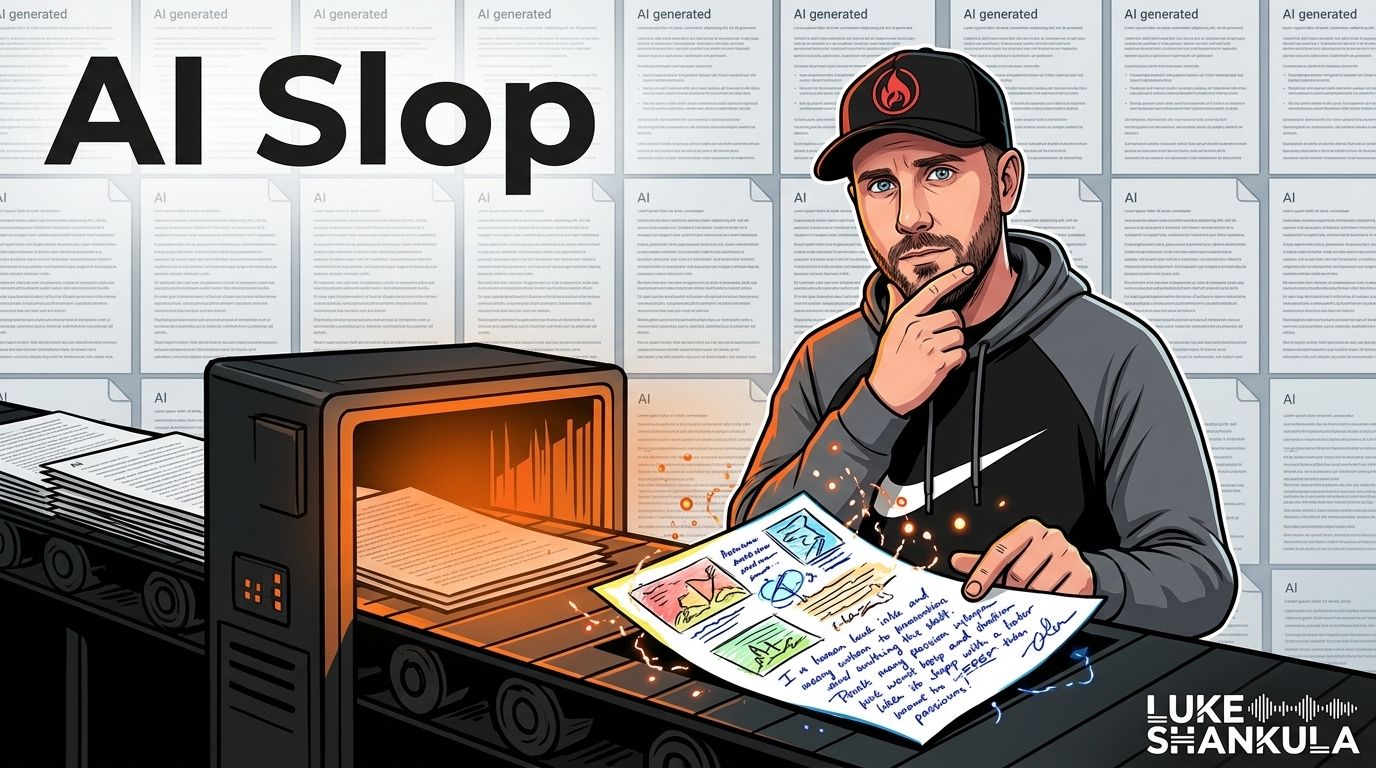
# AI Slop: Why All AI Content Sounds the Same (And the One Move That Fixes It) (2026)
Every AI-written post on the internet right now sounds like the same person wrote it. The same opening hooks. The same "It's not just X, it's Y" cadence. The same em dashes everywhere. The same hollow conclusion paragraphs that end with a vague call to action about embracing the future. There is now a name for it. People are calling it AI slop, and the searches for that exact phrase have grown over 500% year over year. The reason isn't that AI is bad at writing. The reason is that almost everyone is using AI the same way, and getting the same output, and posting it without changing anything. The fix isn't to use AI less. It's to use AI differently. This is a guide to what AI slop actually is, why it happens, how to recognize it in your own work, and the one move that produces AI content that still sounds like a real person wrote it.
What is AI slop?
AI slop is the homogenized, low-effort content produced when someone uses a general-purpose AI tool like ChatGPT or Claude with a generic prompt, accepts the first output, and publishes it without revision. The defining characteristic is sameness. AI slop reads like every other piece of AI slop because the underlying language model has converged on a small set of default rhetorical patterns, and most users never break out of those defaults.
The term started showing up in tech discourse in 2024 and gained mainstream use through 2025 as social platforms, news sites, and SEO results filled up with content that all sounded like the same writer. Search interest in "ai slop" has grown more than 511% over the past 12 months according to DataForSEO trend data, with 33,100 monthly searches as of early 2026. Adjacent searches like "ai garbage" and "ai is trash" are growing alongside it. People aren't searching for these phrases because they want to learn about AI. They're searching because they're encountering it everywhere and want a word for what they're seeing.
The simplest way to think about AI slop is this: if you can read three paragraphs of a piece and tell it was AI-written without any other clues, it is AI slop. Not because AI was used. Because the writer didn't do anything to make the output sound like them.
Why does AI slop happen?
There are four mechanics behind it, and understanding them is the foundation for the fix.
Training data convergence
Every major language model is trained on overlapping sources: Common Crawl, Wikipedia, Reddit, books, news archives. They've all seen most of the same writing. When you give any of them a generic prompt like "write a LinkedIn post about productivity," they all reach for the same patterns because those patterns were statistically rewarded across their training data. Different models, similar output. This isn't a bug. It's the predictable result of language models doing exactly what they were built to do.
RLHF reward hacking
The second layer is reinforcement learning from human feedback. After the base model is trained, human raters score outputs and the model learns to optimize for what scores well. Raters tend to score the same way: clarity, structure, positive tone, hedged claims, balanced perspective. The model learns to produce content that hits those targets, which means hollow opening hooks, perfectly balanced paragraphs, and conclusions that affirm whatever the user prompted. There are good papers on this from Anthropic and others. The short version: the more RLHF, the more the model sounds like a polite assistant. The more it sounds like a polite assistant, the more all of its output sounds the same.
Prompt convergence
The third mechanic is the part nobody talks about. Most people who use AI for content use the same prompts. They got the prompts from the same Twitter threads, the same YouTube tutorials, the same "10 ChatGPT prompts for marketers" listicles. So even though the underlying model is capable of vast variation in output, the inputs are converging. Same prompt plus same model equals same output. The tutorial industry built the slop problem.
Default model behavior
The fourth is the easiest to fix and the most ignored. The model has a default voice. If you don't tell it not to, it will use that voice every time. The default voice is the one that scored well in RLHF: balanced, clear, structured, slightly formal, vaguely optimistic. If you write social posts in your real voice and they sound nothing like that, the model will not produce your voice by default. It will produce the assistant voice. Most people don't realize the assistant voice isn't a voice. It's the absence of a voice.
How do you recognize AI slop?
There are about ten signatures. If you see three or more in the same piece, it was almost certainly produced with minimal effort on top of a generic prompt.
- Em dashes everywhere. AI models love em dashes. Real writers vary their punctuation.
- "It's not just X, it's Y" cadence. Or "It's not about X. It's about Y." Both are AI tells.
- Triple parallel constructions. "Faster, smarter, better." "Build, ship, iterate." Three rhythm beats with abstract nouns.
- Hollow opener hooks. "In today's fast-paced world." "In the current landscape of." "Artificial intelligence has revolutionized." Filler that says nothing.
- Hedged claims. "Some experts suggest that..." "Many would argue..." Used to soften any actual opinion until there's no opinion left.
- The "key insight" reveal pattern. "Here's the key insight." "The bottom line is." Setup phrases that promise something the next sentence rarely delivers.
- Closing call to action about the future. "Embrace this technology." "The future is here." Vague exhortations that commit to nothing.
- Bulleted lists where prose would be better. AI defaults to lists because lists scored well in training. Real writing flows.
- The "let's break it down" transition. Or "let's unpack." Phrases that exist to fill structure rather than carry meaning.
- Same word choices across totally different topics. The same model used for a finance post and a fitness post will reach for "robust," "leverage," "navigate," "elevate," and "seamless" in both, because those are its high-confidence vocabulary.
The reason these are easy to recognize is that they are the same in everyone's AI output. Once you know what to look for, you start seeing it on every LinkedIn post, every blog header, every newsletter. The internet now has a measurable layer of homogenized text on top of it, and that's what people mean when they say "AI slop."
What actually works instead?
The fix is not to use AI less. The fix is to put something between the model and the output that makes the output sound like you. There are a few ways to do this, ranked from cheapest to most durable.
Edit aggressively
The lowest-effort fix is to take any AI output and edit out the AI tells before publishing. Strip the em dashes. Rewrite the "It's not just X, it's Y" sentences. Cut the hollow openers. Replace generic transitions with how you actually talk. This works for one-off posts. It does not scale, because every piece requires the same manual work, and most people who start editing aggressively eventually stop because the edit phase is more work than just writing the thing themselves.
Use voice prompts
The next step up is to teach the model your voice in the prompt every time. Paste in three real examples of your writing, then ask the model to write the new piece in that voice. This works better than nothing. The problem is the voice context decays over a long conversation, the model still reaches for its defaults when you turn the dial too quickly, and you have to maintain the voice prompt forever.
Build a voice-trained second brain
The durable fix is to capture your actual voice once, in depth, and load that voice into the model permanently as the default for everything you produce. This is what Claude Projects, custom instructions, and skill files exist for. You don't tell the model your voice for every prompt. You tell it your voice once, at the foundation, and it produces in your voice every time without you reminding it.
The challenge is that most people don't know how to describe their own voice well enough to capture it. Asking yourself "what makes my writing sound like me" is harder than it seems. You end up with descriptions like "conversational and direct" that match a million other people's writing too.
This is the problem I built Duplico to solve.
The voice-first approach
Duplico runs a guided voice interview that captures how someone actually speaks, then translates the speech patterns into a structured voice profile that loads into AI tools. The output isn't a description of your voice. It's a working representation of your voice that the model can produce against. The thesis is simple: your humanness is your moat. In a world where everyone has access to the same AI tools, the only durable competitive advantage is sounding like a specific real person instead of sounding like every other AI-assisted writer on the internet.
I'm not claiming this is the only way. There are other approaches and there will be more. The point is that the fix for AI slop is structural. You have to put something between the model and your output that's specific to you. If you don't, the output will be specific to nobody.
What does AI content that doesn't sound like slop look like?
Three properties.
One: it sounds like a specific person. You can read it and form a sense of who wrote it. Their pacing. Their word choices. Their typical sentence length. Their opinions. The opposite of "this could have been written by anyone."
Two: it has unhedged opinions. AI slop is full of "many would argue" and "it depends on your situation." Real content takes a side. The writer cares about something specific and the reader can tell what that thing is.
Three: it earns the words it uses. AI slop is full of high-confidence vocabulary that's doing no work. "Robust framework." "Strategic approach." "Innovative solution." Those words are stickers. Real content uses specific words that carry information. "The 14-day cancellation window." "The 8-hour deploy." "The version that broke at 200 concurrent users."
If a piece has those three properties, it is hard to mistake for AI slop even if AI was used to produce parts of it. The presence of AI in the production pipeline is not the problem. The absence of a human voice on top of the output is the problem.
Is AI slop getting worse or better?
It's getting worse and the rate is accelerating. Three reasons.
Search volume on "ai slop" grew over 511% year over year per DataForSEO. That's a recognition signal. The audience can name the problem now, which means they can sort against it.
Models keep getting better at the polite-assistant voice through more RLHF. Every model update reinforces the default behaviors that produce slop. Better at the default, more obvious when the default is on display.
Detection is converging with production. The same models that produce AI slop are getting better at recognizing AI slop. Originality.ai, GPTZero, and others now flag AI content with high accuracy. Search engines and ad networks are starting to deprioritize content that reads as low-effort AI, which means the SEO penalty for slop is going to grow.
There's also a small but real second-order effect: as the internet fills with AI slop, the next generation of models will be trained partially on that slop. Researchers call this model collapse. Recursive training on synthetic content has been shown to degrade output diversity over time. We're at the beginning of a slow feedback loop where AI is starting to eat AI, and the human writing left in training data becomes more valuable, not less.
The conclusion isn't that AI is over. It's that the people who win with AI from this point forward are the ones who treat AI as a leverage tool on top of their actual voice, not as a replacement for having a voice in the first place.
How can I make sure my AI content doesn't sound like slop?
Five practical moves anyone can make this week.
- Capture your voice once, in depth. Write or record 5,000 words of your real speech and writing. Use it as the foundation for every AI tool you set up after that.
- Build voice-trained skills, not voice-described skills. Saying "write in a conversational tone" is useless. Loading 30 examples of your actual writing into a Claude Project is durable.
- Read your output before you publish it. If you cannot tell whether you wrote it or AI wrote it, AI wrote it. Rewrite the parts that sound like AI until they sound like you.
- Strip the AI tells deliberately. Search for em dashes. Search for "It's not just." Search for "leverage" and "elevate" and "navigate." Delete or rewrite every instance. Make this part of your publish checklist.
- Take an opinion. AI defaults to balance. Real writing has a side. If you cannot tell what you actually think about the topic, the AI cannot either, and the output will read as empty because it is empty.
The bigger move underneath all five is this: stop thinking of AI as a content generator. Start thinking of it as a content amplifier for the voice you already have. If you don't have a voice yet, the AI can't help you. If you do, the AI can multiply how often that voice shows up in the world.
Frequently asked questions
What's the difference between AI slop and AI-assisted writing? AI-assisted writing is writing where AI participated in the production process and the final output sounds like a specific human. AI slop is writing where AI produced most of the output and nobody put their voice on top of it before publishing. Same tools, different process, completely different results.
Can AI detect AI slop? Yes, and increasingly well. Tools like Originality.ai and GPTZero can identify AI-generated content with high accuracy, and search engines have started weighting their algorithms against low-effort AI content. The detection arms race favors the human voice over the long term.
Does using ChatGPT or Claude automatically produce slop? No. Using them with a generic prompt and zero post-processing produces slop. Using them with a voice-trained foundation and editing your output produces content that benefits from AI leverage without sounding like AI.
Is "AI slop" the same as "AI hallucination"? No. Hallucination is when AI makes up facts. Slop is when AI produces homogenized, low-effort content. A piece can be factually accurate and still be slop if it sounds like every other AI-written piece.
Will AI content always sound like AI? Only if you let it. The default behaviors that create slop are the easiest path for the user, which is why they're so common. The fix is structural: capture your voice, load it into your tools, and the output starts sounding like you instead of like the assistant voice.
Is it possible to write a post entirely with AI and have it not be slop? Yes, if you've done the voice capture work upfront. The AI does the typing, your voice profile does the styling. The output reads as yours because the underlying instructions were yours. The labor moves from the keyboard to the foundation.
What does "your humanness is your moat" actually mean in practice? It means that in a market where everyone has the same AI tools, the only sustainable advantage is being recognizably yourself. Voice, opinion, taste, and specificity can't be copied by your competitor's prompt. They can only be built by you, over time, and then amplified by AI.
Who is most at risk of producing AI slop without realizing it? People who use AI as a shortcut to skip the thinking step. If you don't have a clear opinion or a real point of view before you prompt the model, you'll get a default opinion from the default model, and so will everyone else who used the same shortcut.
Want to see what voice-first AI content production actually looks like?
I built Duplico because I needed it for my own business and the existing tools couldn't solve the problem. It captures your voice through a guided interview, then loads that voice into Claude, ChatGPT, and the rest of your AI stack as the default. You stop sounding like AI slop. You start sounding like you, at scale. There's a deeper write-up of how it works and who it's for at Direct Authority AI, the coaching community where this approach gets taught end-to-end. If you're a marketer or operator who has been trying to use AI for content and watching the output sound like every other AI-assisted post on your feed, that's where to start.
Frequently Asked Questions
What's the difference between AI slop and AI-assisted writing?
AI-assisted writing is writing where AI participated in the production process and the final output sounds like a specific human. AI slop is writing where AI produced most of the output and nobody put their voice on top of it before publishing. Same tools, different process, completely different results.
Can AI detect AI slop?
Yes, and increasingly well. Tools like Originality.ai and GPTZero can identify AI-generated content with high accuracy, and search engines have started weighting their algorithms against low-effort AI content. The detection arms race favors the human voice over the long term.
Does using ChatGPT or Claude automatically produce slop?
No. Using them with a generic prompt and zero post-processing produces slop. Using them with a voice-trained foundation and editing your output produces content that benefits from AI leverage without sounding like AI.
Is "AI slop" the same as "AI hallucination"?
No. Hallucination is when AI makes up facts. Slop is when AI produces homogenized, low-effort content. A piece can be factually accurate and still be slop if it sounds like every other AI-written piece.
Will AI content always sound like AI?
Only if you let it. The default behaviors that create slop are the easiest path for the user, which is why they're so common. The fix is structural: capture your voice, load it into your tools, and the output starts sounding like you instead of like the assistant voice.
Is it possible to write a post entirely with AI and have it not be slop?
Yes, if you've done the voice capture work upfront. The AI does the typing, your voice profile does the styling. The output reads as yours because the underlying instructions were yours. The labor moves from the keyboard to the foundation.
What does "your humanness is your moat" actually mean in practice?
It means that in a market where everyone has the same AI tools, the only sustainable advantage is being recognizably yourself. Voice, opinion, taste, and specificity can't be copied by your competitor's prompt. They can only be built by you, over time, and then amplified by AI.
Who is most at risk of producing AI slop without realizing it?
People who use AI as a shortcut to skip the thinking step. If you don't have a clear opinion or a real point of view before you prompt the model, you'll get a default opinion from the default model, and so will everyone else who used the same shortcut.
Written by
Luke Shankula
Luke Shankula is the founder and CEO of Direct Authority AI, a comprehensive AI-powered platform and coaching community helping mortgage professionals build scalable, agent-independent businesses through AI automation and direct-to-consumer marketing. Based in San Diego, Luke leads a community of 175+ loan officers who are leveraging AI for competitive advantage. He created Duplico, Direct Authority AI's flagship software featuring 50+ AI marketing tools that generate authentic, on-brand content across multiple platforms - from social media and email sequences to video scripts and webinar presentations. Luke has become a sought-after speaker on AI implementation in mortgage, presenting at major industry events including MortgageCon, AIME Fuse, IMN Mortgage AI Conference, and the HMA Sales Rally. His monthly AI Summit attracts 600+ registrants, making it one of the mortgage industry's premier AI education events. His work has been featured in National Mortgage News, NBC, Yahoo Finance, Mortgage Marketing Animals podcast, and The Loan Officer Podcast. Above all, Luke is a husband, father of four, and passionate entrepreneur focused on helping mortgage professionals build businesses they're proud of while staying ahead of technological change in their industry.
Want more insights like this?
I share AI strategies, mortgage marketing tips, and business lessons regularly.