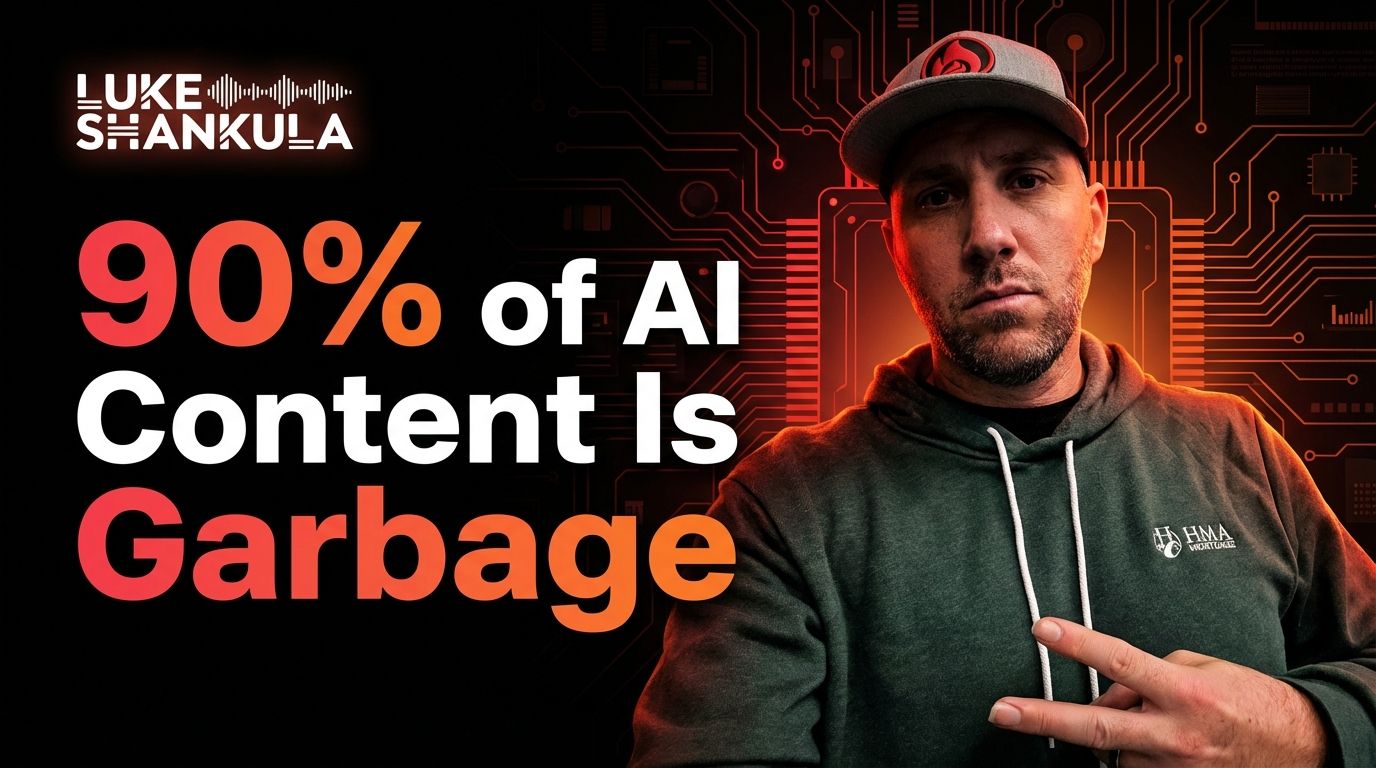
If you've been on social media at all lately, you've seen it.
The AI posts.
You know exactly what I'm talking about. Too many emojis. Weird spacing. Every sentence sounds like it came out of a corporate handbook that's trying really hard to sound casual.
"Ready to unlock your full potential? Here's 5 things I learned on my journey." 🚀🔥👇
It's everywhere right now. Instagram, Facebook, LinkedIn, TikTok - doesn't matter. Real estate agents, loan officers, coaches, business owners - everyone's feeding prompts into ChatGPT and posting whatever comes out like nobody's gonna notice.
But here's the thing: everybody notices.
You're not fooling anyone. Your audience can feel it. That stuff is boring, too perfect, over-structured, and it has absolutely no soul.
And if that's what your content sounds like right now, you're not building an audience - you're training people to scroll past you.
The Problem Goes Deeper Than Bad Prompts
The easy answer is "you just need better prompts." That's what everybody says. "You're using ChatGPT wrong, here's ten better prompts."
And sure, your prompts probably aren't great. But that's not the real problem.
The real problem is that ChatGPT, Claude, Gemini - all of them - they're trained on the same internet. Same data. Same patterns. Same everything.
So when you ask any of these tools to write something for you, you're getting the same structure, the same phrases, the same emoji-loaded, overly positive, says-nothing output as everyone else.
You're not creating anything. You're placing the same order at the same restaurant as everyone else and wondering why your meal doesn't taste special.
Now look - I'm not anti-AI. I built a half-million-dollar software platform for three thousand dollars using AI. No coding background. Just me and these tools. I know what they can do. I use them every single day.
And I'm telling you - the output is only as good as the input. And right now, most people's input is garbage.
What "AI Slop" Actually Looks Like
Here's what happens when you type something like "Write a social media post about why people should work with me" into ChatGPT.
You get back something like:
"In today's competitive market… Don't miss out… Reach out today to get started on your journey… I'm passionate about helping people achieve their goals."
And of course - emojis everywhere.
That is AI slop. It's not wrong...it's just dead. There's no personality in it. No emotion or original point of view. It reads like a robot doing an impression of a motivational speaker - and not a good one.
And the reason this matters so much right now is that people are craving the opposite.
Think about what your feed looks like. It's a wall of this stuff. Manufactured, overly polished, says-all-the-right-things content that makes you feel nothing.
People are exhausted by it. They're scrolling past all of it.
Because what people actually want - what they've always wanted - is real human connection. Something that sounds like a person wrote it. Something with an actual opinion. Something that isn't perfectly structured and carefully optimized and wrapped up in a bow with a rocket emoji on top.
What Actually Stops the Scroll
Every once in a while, I'll be going through my feed and something actually stops me. Not often. Maybe three out of every fifty posts actually make me want to click the profile and learn more about that person.
Here's what those posts have in common.
The first one: Someone told a real story. Not a polished, everything-worked-out story. A messy one. Something that almost went sideways, what they were doing at eleven at night trying to save it, how it actually felt. You could tell they lived through it.
The second one: Someone shared an opinion that most people would be too scared to post. Something honest that went against their own interest. The kind of thing where you read it and go - okay, this person isn't just performing for likes. They actually mean this.
The third one: Someone admitted they made a mistake. Not in a fake way. They talked about what happened, what it cost them, what they'd do differently.
Three totally different posts. Three totally different people. But one thing in common.
They all sounded like a specific human being. Not a template or an AI output. A real person with a real voice and something real to say.
And that's the only thing that can't be copied right now. AI is commoditizing everything - code, design, writing, analysis - it can all be generated now. But it can't be you. Your stories, your opinions, the way you actually explain things when you're just talking to someone.
Your humanness is your moat. It's the one thing these tools can't replicate. And right now, because everything around it is so manufactured, even a little bit of authenticity stands out like crazy.
3 Ways to Fix Your AI Content Today
Here's the good news. You don't need to stop using AI. You just need to use it differently. Here are three things you can do today - before you post anything else.
1. The Banned Words Test
I keep a running list of words and phrases that are dead giveaways for AI-generated content. If any of these show up in your stuff, it needs a rewrite:
- "In today's market"
- "Navigate"
- "Leverage"
- "Don't hesitate to reach out"
- "Streamline"
- "It's important to note"
- "Unlock"
- "I'm passionate about"
I put together a full checklist you can download for free - [grab the Banned Words Checklist here].
Here's the thing about these words. They aren't wrong. They're just invisible. Your brain has seen them so many times it skips right over them. And content your brain skips over might as well not exist.
Run your stuff through that list. If it fails, rewrite it using words you'd actually say out loud.
2. Feed AI Your Voice First
This one changed how I think about AI completely.
What if instead of giving AI a prompt and getting back some lifeless paragraph with four emojis - you gave it your voice first?
Here's what I mean. Take out your phone right now and record yourself answering one question. Just one:
Why did you get into what you do?
Not the polished version or some "about me" page version. The REAL answer. The one you'd tell a friend over drinks. Talk for two or three minutes. Just go.
Then transcribe it. Paste that transcript into ChatGPT and say "write in this style."
Watch what happens.
The output sounds completely different. Because now AI isn't pulling from the same generic data as everyone else - it's pulling from you. Your words. Your rhythm. Your way of explaining things.
That's the whole concept behind everything I teach. I go deeper on this in The Voice-First Method. When the input is actually you, the output stops sounding like a robot. It sounds like you on a good day.
The principle stays the same no matter what tool you use: Garbage in, garbage out. Generic prompt equals generic content. Your actual voice equals something nobody else can copy.
3. The "Would I Say This at a Bar?" Test
This one's almost embarrassingly simple.
Before you hit post on anything, read it out loud. Not in your head - out loud, like you're talking to someone.
And ask yourself: would I actually say this to a friend over drinks?
Like would you ever look someone in the eye and say "I'm passionate about helping people navigate their journey to achieve their goals in today's competitive landscape"?
No. Nobody talks like that. You'd just say what you mean in normal words.
That's how your content should sound. If you wouldn't say it face to face, don't post it. Simple as that.
What This Looks Like When Someone Actually Does It
I've spent over five years working with professionals on their content - particularly in the mortgage industry, where everybody sounds exactly the same.
One of the people I work with, Paul Byron, was doing the same thing everybody else does. Using ChatGPT, getting generic output, posting it and hoping for the best. Fine content. Forgettable content.
He switched to a voice-first approach - captured how he actually talks, fed that into the system, and started posting as himself instead of as a template.
One post. 2.4 million views. And he closed a $699,000 loan directly from it.
Same person. Same expertise. Same platform. The only thing that changed was the content sounded like him. That's it. That's the whole difference.
Why I Built a Whole Platform Around This
You can absolutely do all of this manually. Record yourself, transcribe it, paste it into ChatGPT, prompt it, tweak it, repeat. It works. But it's slow.
That's why I built Duplico - an AI content platform that captures your voice automatically through an interview process, then uses that as the foundation for everything it generates.
No more starting from a generic prompt. No more "in today's competitive market." The AI starts with you - your personality, your stories, your style - so the output sounds like a human wrote it. Because one did. The AI just helped them do it faster.
It's included inside Direct Authority AI, the coaching community I run for professionals who are serious about standing out with their content.
Start your 7-day free trial of Duplico →
The Bottom Line
AI is commoditizing everything right now. Code, design, writing - anyone can generate it.
But the people who are going to stand out over the next few years aren't the ones using the best tools. They're the ones who still sound like themselves when they do. If you are not sure where to start, I wrote a breakdown of the only AI tools you actually need.
Right now people are scrolling through feed after feed of AI-generated noise looking for something that feels real.
Be that.
Clone yourself with AI. Just make sure what you're cloning is worth replicating.
Your humanness is your only moat. Make it count.
📋 Want the free Banned Words Checklist? Download it here - then go look at your last five posts and count how many banned words you find. I promise it's higher than you think.
🎥 Watch the full video version of this post - Watch on YouTube
Frequently Asked Questions
Why does AI-generated content all sound the same?
All major AI models - ChatGPT, Claude, Gemini - are trained on the same internet data. When you give them generic prompts, they produce statistically average output using the same phrases and structures everyone else gets. The input determines the output.
How do I make AI content sound like me?
Record yourself talking naturally for 2-3 minutes answering a question about your work. Transcribe it, then paste that transcript into the AI and tell it to write in that style. This gives the AI your actual voice patterns instead of pulling from generic training data.
What words are dead giveaways for AI-generated content?
Common AI tells include phrases like "in today's market," "navigate," "leverage," "don't hesitate to reach out," "streamline," "it's important to note," "unlock," and "I'm passionate about." If these appear in your content, rewrite using words you would actually say out loud.

Written by
Luke Shankula
Luke Shankula is the founder and CEO of Direct Authority AI, a comprehensive AI-powered platform and coaching community helping mortgage professionals build scalable, agent-independent businesses through AI automation and direct-to-consumer marketing. Based in San Diego, Luke leads a community of 175+ loan officers who are leveraging AI for competitive advantage. He created Duplico, Direct Authority AI's flagship software featuring 50+ AI marketing tools that generate authentic, on-brand content across multiple platforms - from social media and email sequences to video scripts and webinar presentations. Luke has become a sought-after speaker on AI implementation in mortgage, presenting at major industry events including MortgageCon, AIME Fuse, IMN Mortgage AI Conference, and the HMA Sales Rally. His monthly AI Summit attracts 600+ registrants, making it one of the mortgage industry's premier AI education events. His work has been featured in National Mortgage News, NBC, Yahoo Finance, Mortgage Marketing Animals podcast, and The Loan Officer Podcast. Above all, Luke is a husband, father of four, and passionate entrepreneur focused on helping mortgage professionals build businesses they're proud of while staying ahead of technological change in their industry.
Want more insights like this?
I share AI strategies, mortgage marketing tips, and business lessons regularly.