Claude vs ChatGPT vs Gemini: What Actually Matters When You're Creating Content
 Luke Shankula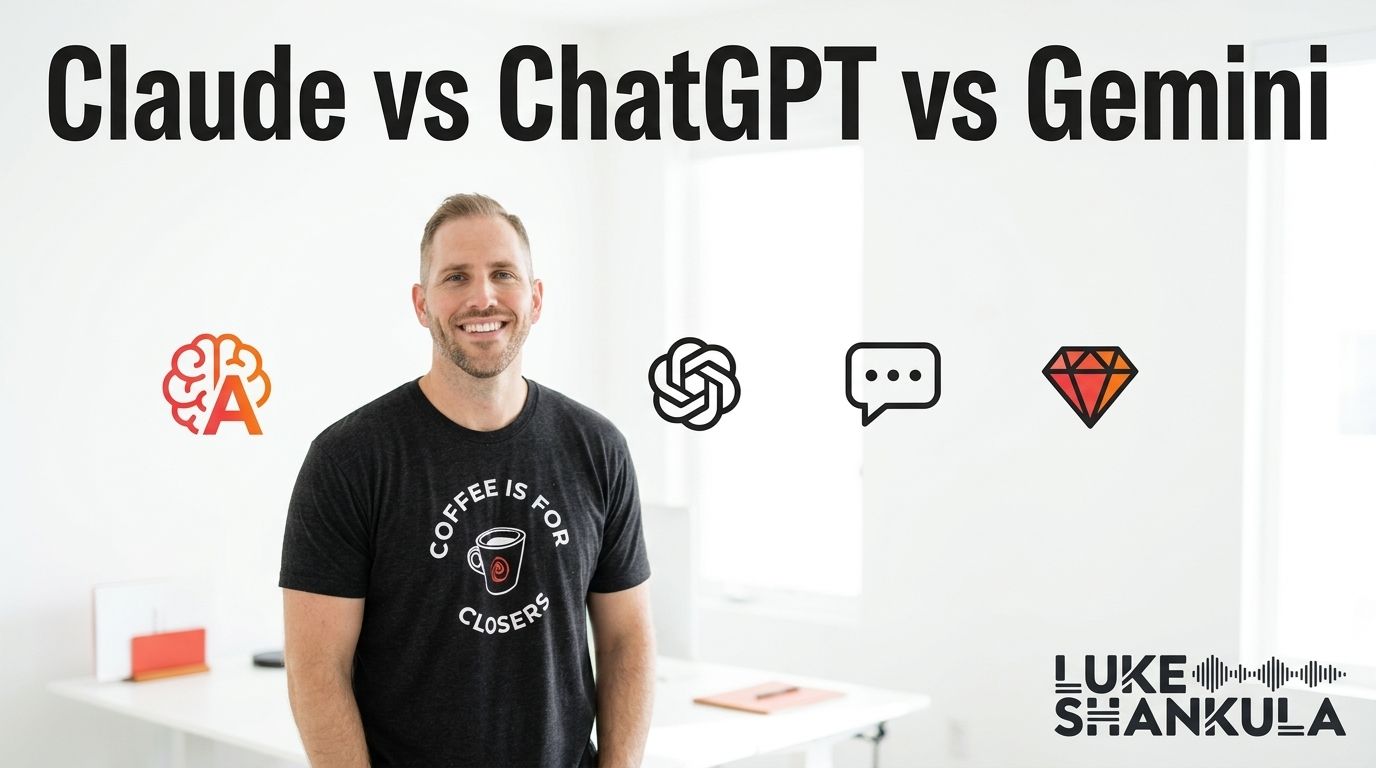
If you're comparing Claude vs ChatGPT for content creation, here's the short answer: Claude is better. It writes more like a human, follows instructions more precisely, and is honest about what it can and can't do. ChatGPT is stronger for coding and integrations. Gemini is useful for research. But if you're building content for your business, Claude wins and it is not particularly close.
Now let me explain why I can say that with a straight face.
Why Most AI Comparisons Are Useless
Go search "Claude vs ChatGPT" right now. You'll find a bunch of articles that compare feature lists. Token limits. Pricing tiers. Benchmark scores.
None of that tells you what it's actually like to sit down with these tools every day and try to get real work done.
I've used ChatGPT, Claude, and Gemini daily for over two years. I'm not reviewing these from a press release or a demo video. I'm telling you what happens when you open these tools at 6am and need to produce content that sounds like you, ranks on Google, and actually moves your business forward.
Most comparison articles compare specs. I'm going to compare what it actually feels like when you have a business to run and content to create.
The best AI for content creation is the one that gets out of your way and makes your voice louder. Features on paper don't tell you which one does that.
The Three-Tool Breakdown (From Someone Who Uses All Three)
Where Claude Wins for Content
Claude is the best AI for content creation right now. I say that as someone who wanted ChatGPT to stay on top. I was a ChatGPT user first. I built my early systems there. But once I started using Claude seriously, the gap became obvious.
Voice replication. This is the big one. When you give Claude examples of how you write and tell it to match your voice, it actually does it. The output sounds like a human wrote it. ChatGPT tends to add that polished, corporate sheen to everything. You know the tone I mean. It sounds "written." Claude sounds talked.
Framework following. If you give Claude a detailed framework - "write a blog post with this structure, these proof points, this tone" - it follows the instructions. It doesn't add extra sections you didn't ask for. It doesn't rearrange your outline because it thinks it knows better. It does what you asked.
Context window honesty. Claude will straight up tell you when it's running out of context. Whereas ChatGPT makes you feel like it still has context and keeps going, but really the quality drops silently. You think you're getting good output. You're not. ChatGPT keeps nodding along even after it's forgotten half of what you told it. Claude tells you the truth.
Marketing copy quality. I said this at our March Summit and I'll say it here: Claude is considerably better for marketing copy. The writing is tighter. The sentences are shorter. It requires less editing to sound like a real person wrote it.
The skills system. Claude Skills let you build reusable frameworks - voice guides, content templates, research workflows - and Claude applies them consistently.
If you're creating content for your business, Claude is the tool to learn first. Full stop.
Where ChatGPT Still Has the Edge
I'm not a fanboy. I use what works. And there are areas where ChatGPT is the better choice.
Coding and technical work. If you're building automations, writing scripts, or debugging code, ChatGPT (especially with GPT-4) is more reliable. It handles technical tasks with fewer errors and integrates with more developer tools.
Third-party integrations. ChatGPT connects to more things. Zapier, Make, your CRM, your calendar. The plugin system is bigger. If your workflow depends on connecting AI to other software, ChatGPT has the wider reach.
Image generation. DALL-E is built into ChatGPT. You can create images inside the same conversation. Claude doesn't generate images at all.
Custom GPTs for sharing. If you want to build a tool and hand it to someone else - a client, an agent partner, a team member - Custom GPTs are easy to share. You build it once and send a link. Claude's Projects work great for your own use but sharing is more limited.
Familiarity. More people have used ChatGPT. More tutorials exist. If you're training a team or working with someone who's new to AI, ChatGPT has a lower learning curve simply because it's been around longer.
These are real advantages. I still use ChatGPT for certain tasks every week. The point isn't that one tool is bad. The point is that for content creation specifically, Claude does it better.
Where Gemini Fits (And Where It Doesn't)
Gemini is Google's AI. That matters for one big reason: it's connected to the Google world. Search, Docs, Gmail, YouTube.
Research. When I need to pull information, compare sources, or get a broad overview of a topic, Gemini does solid work. It has access to current search results and can put together what's out there.
Google Workspace integration. If your entire workflow lives in Google Docs and Sheets, Gemini fits right in. It reads your documents and works inside the tools you're already using.
Multimodal input. Gemini handles video, images, and long documents well. If you want to analyze a YouTube video or process a big PDF, it's capable.
But for content creation? Gemini is third place.
The voice quality isn't there. The output reads more like a summary than a piece of content someone would actually want to read. It's fine for drafting internal docs or pulling together research. It is not the tool I'd use to write a blog post, an email, or a social post that needs to sound like me.
I keep Gemini in my rotation for research tasks. I do not use it to create anything that goes in front of an audience.
What This Actually Looks Like Day to Day
Here's a real example. I needed to write a follow-up email after a coaching call. Same task, three tools.
ChatGPT: I pasted the call transcript and asked for a follow-up email. It gave me something polished. "Thank you for joining today's session. I wanted to follow up on the key takeaways we discussed." Professional. Forgettable. Sounds like every other automated email.
Gemini: Similar prompt. It summarized the call well but the email read like a report. Bullet points of what was covered. Useful internally, but not something I'd send to a real person.
Claude: Same transcript, same prompt. It pulled the specific thing the person asked about, referenced it naturally, and wrote in my voice because it already had my style loaded. The email sounded like I sat down and typed it myself. Took 30 seconds to review and send.
That's the difference in practice. Not benchmark scores. Not token limits. The actual output when you need to get something done at 7am before your first call.
I use all three tools every week. Claude handles content. ChatGPT handles code and integrations. Gemini handles research. But if I could only keep one, it's Claude - because content is what moves the business.
The Bigger Picture: Your Tool Matters Less Than Your System
Here's the part that most people skip when they're comparing Claude vs ChatGPT vs Gemini.
The tool is maybe 20% of the equation. The system you build around it is the other 80%.
I've watched people bounce between ChatGPT, Claude, Gemini, Perplexity, and whatever new thing launched this week. They spend more time testing tools than creating content. That is a trap.
Pick one tool for content. Learn it deeply. Build your frameworks in it. Build your voice profile in it. Build your second brain in it.
I recommend Claude for content creation. But honestly? Someone who masters ChatGPT and builds a real system will outperform someone who has Claude but uses it randomly with no framework.
Your humanness is your moat. The AI is a magnifier for everything you already bring to the table. If you're feeding it garbage prompts with no structure, you'll get garbage output regardless of which tool you picked.
So yes, Claude vs ChatGPT matters. But how you use it matters way more.
What to Do Next
If you've been going back and forth between tools, stop. Pick Claude for content. Pick ChatGPT for the technical stuff it does better. And build a system so you're not starting from scratch every time you sit down to create.
If you're ready to switch from ChatGPT, I wrote a full guide on how to transfer everything over to Claude - including your memory, your workflows, all of it.
And if you want help building the actual content system - the voice profile, the frameworks, the whole production pipeline - that's exactly what we do inside DAI.
Frequently Asked Questions
Is Claude better than ChatGPT for writing?
For content creation and marketing copy, yes. Claude produces more natural-sounding writing, follows voice guidelines more accurately, and is honest about its context limitations. ChatGPT still edges ahead for coding, technical writing, and tasks that need integrations with other tools.
Is Claude AI free?
Claude offers a free tier with limited usage. For serious content creation, you'll want Claude Pro which is $20/month. That gives you access to the latest models and higher usage limits.
Can Claude replace ChatGPT?
For content creation, yes. I've moved almost all of my content workflows to Claude. For coding, integrations, and image generation, I still use ChatGPT. Most people who create content for their business will find that Claude handles 80%+ of what they need.
Which AI is best for marketing content?
Claude. The voice matching is better, the framework following is tighter, and the writing quality requires less editing. I've used all three major AI tools daily for over two years and Claude produces the best marketing copy by a clear margin.
Is Gemini better than Claude?
For research and Google Workspace integration, Gemini has advantages. For content creation, Claude is better. Gemini's output tends to read more like a report than a piece of engaging content.
What is the best AI for small business content?
Claude, paired with a system for using it. The tool alone won't fix your content. You need a voice profile, content frameworks, and a process for turning your knowledge into posts, blogs, and emails.
Want more insights like this?
I share AI strategies, mortgage marketing tips, and business lessons regularly.