How to Create a Month of Content in One Hour (The AI Workflow That Actually Works)
 Luke Shankula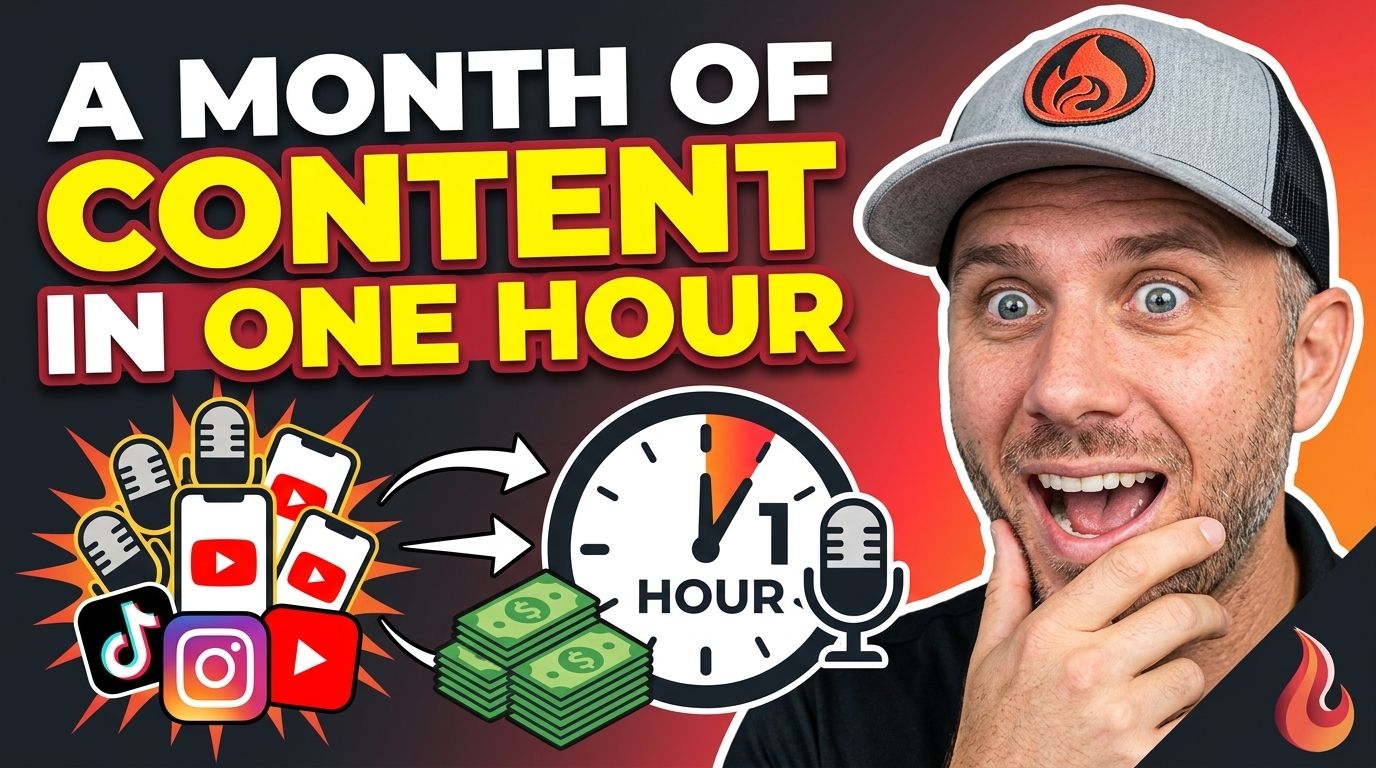
The number one reason professionals don't post on social media is time.
They know they should be creating content. They've seen what consistent posting does for other people in their industry. They understand that being visible online matters more than it ever has. But between running their actual business, serving clients, and managing everything else, sitting down to write a week of posts feels impossible.
Here's what changed. The professionals I work with are creating 30 days of social media content in about an hour using AI. Some do it faster. And the content doesn't sound like it came from a robot - it sounds like them.
This isn't about blasting out generic AI content that nobody reads. This is about a specific workflow that starts with your voice and ends with a month of posts scheduled and ready to go. Let me walk you through it step by step.
Step 1: Record Yourself for 15 Minutes
This is the step everyone wants to skip. It's also the one that makes everything else work.
Before you open any AI tool, grab your phone and hit record. Talk about 3 to 5 topics you know well. Just talk like you're explaining something to a friend. No script. No preparation. Just you being you.
Some ideas to get you started: a story about a recent client win or a project that went sideways and what you learned from it. Your honest take on something happening in your industry right now. A tip or insight that took you years to learn but most people in your field don't know. Something you wish your clients understood before they hire someone like you. A mistake you see people in your industry making over and over.
Spend about 3 minutes per topic. Don't worry about being polished or articulate. The messiness is the point. That's your real voice - the way you actually talk when you're not trying to sound professional. And that authentic sound is exactly what makes your content different from everyone else's.
When you're done, you have 15 minutes of raw material that sounds like you, covers topics your audience cares about, and gives AI the context it needs to create content in your voice instead of a generic one.
I wrote a whole post about why this voice-first approach matters so much in The Voice-First Method. The short version: AI can only sound like you if you give it something real to work from.
Step 2: Transcribe and Feed It to AI
Take your recordings and transcribe them. Wispr Flow, Otter, or your phone's built-in transcription will work fine. You don't need a perfect transcript. You just need the words.
Open Claude, ChatGPT, or whatever AI writing tool you use and paste your transcript with instructions like this:
"Here's a transcript of me talking about topics in my industry. Use my exact tone, phrasing, and style as the foundation. Create 5 social media posts from this material. Each post should be 150 to 300 words, written in first person, and sound like I'm talking directly to one person. Use short paragraphs with one sentence per line. No emojis. No hashtags in the body."
That prompt plus your transcript gives AI enough context to produce content that sounds like you wrote it.
If you want to skip the manual transcribe-and-paste process, that's what I built Duplico for. It captures your voice through an interview once, then generates content that already sounds like you from the first draft. But the manual approach works great too - the important thing is starting with your voice, regardless of the tool.
Step 3: Edit for 10 Minutes
This is where most people go wrong. They either post the AI output without reading it (which produces content that feels slightly off) or they rewrite the entire thing from scratch (which defeats the purpose of using AI in the first place).
The sweet spot is a quick editing pass. Read each post out loud. If any sentence sounds like something you'd never actually say, change it. If a word feels too corporate or too polished, swap it for the word you'd actually use. If the opening line is generic instead of specific, rewrite just that first sentence.
This should take about 2 minutes per post. For a batch of 8 to 10 posts, you're looking at 15 to 20 minutes of editing. That's still dramatically faster than writing everything from scratch.
The quality check I use is what I call the bar test. Read the post out loud and ask yourself: would I say this to someone at a bar? If it sounds natural and conversational, it's ready. If your friend would look at you weird because you just said something like "harness the power of authentic storytelling" out loud, it needs another pass.
Step 4: Create the Visuals
Every post needs a visual. The algorithm rewards visual content on every platform, and your audience scrolls past plain text without stopping.
You have a few options depending on how much time you want to spend.
Google's Nano Banana models can create custom images from a simple text description. Describe what you want - "professional graphic with the text 'The 5 Biggest Myths About [Your Industry]' in a clean modern style" - and you'll have something in 30 seconds. Nano Banana Pro gives you studio-quality results with accurate text rendering. Nano Banana 2 is nearly as good but faster.
Ideogram is excellent when you need stylized text baked into the image. Thumbnails, quote graphics, anything where the words on the image matter as much as the visual.
For professionals who want to move fast, create 3 to 4 template styles in Canva and rotate through them. A quote graphic, a tip graphic, a stat graphic, and a photo with text overlay. Swap the text for each post and you have consistent branding without starting from scratch every time.
The visual doesn't need to be a masterpiece. It needs to stop someone from scrolling. A clean image with readable text and your branding does that.
Step 5: Schedule Everything
Once your posts are written and your visuals are ready, schedule them out for the month. Most professionals do well posting once a day on their primary platform, 5 days a week. That's 20 posts a month, which you just created in about an hour.
Use whatever scheduling tool makes sense for you. Most social platforms have built-in scheduling. If you use a CRM or marketing platform, it probably has social posting features too. The tool doesn't matter. What matters is that the content is scheduled and goes out consistently whether you remember to post that day or not.
Consistency is what compounds. One post that gets 50 views doesn't feel like much. Twenty posts that each get 50 views means 1,000 people saw your face and your expertise this month. Do that for three months and you've been in front of your audience 3,000 times. That's how you go from invisible to recognizable.
Why Starting With Your Voice Changes Everything
Most professionals who try AI for content skip the recording step. They open ChatGPT and type "write me a LinkedIn post about [industry topic]." The output sounds like every other AI-generated post on the platform because it is. There's nothing unique about it. No personality. No stories. No reason for anyone to follow this person instead of anyone else.
When you start with your voice - your actual words, recorded in your actual tone - the AI has something real to work with. It's not generating content from generic training data. It's reshaping your ideas and your stories into posts that still sound like you.
That's the difference between content people scroll past and content that gets saved, shared, and replied to.
I've seen this play out hundreds of times. One of the professionals I work with, Paul Byron, used this voice-first approach and one of his posts hit 2.4 million views. Another, Gustavo, got 8 qualified appointments from a single post. The content worked because it felt real. It felt like a person, not a content machine.
Your humanness is your moat. AI should make you sound more like yourself, not less.
What to Post About When You're Stuck
Even with this system, some weeks you'll sit down to record and draw a blank. Here's a cheat sheet of content categories that work in any industry.
Stories from your work. Your best content comes from real experiences. A project that went well. A client you helped through a tough situation. A creative solution you came up with. A mistake you made and what it taught you. These posts get the most engagement because people connect with real stories more than polished advice.
Educational content your audience needs. Break down something complex in your field. Explain a process most people don't understand. Clarify a common misconception. Teach something that took you years to learn. This builds trust and positions you as the expert.
Your take on industry trends. When something changes in your field, your audience wants to hear from someone they trust. Give them your honest perspective. What does this change mean for them? What should they do about it? Opinion content establishes you as someone who thinks, not just someone who repeats.
Behind the scenes. Show what your day actually looks like. The tools you use. The process behind a project. A quick video about something you learned this week. This humanizes you and makes people feel like they know you before they ever hire you.
Content that helps the people who refer you business. Tips and resources for the partners, colleagues, and contacts who send clients your way. Content that serves your network keeps those relationships warm without you having to make awkward "just checking in" calls.
Rotate through these five categories and you'll never run out of material.
The Metrics That Actually Matter
Social media metrics can be confusing. Most professionals either obsess over the wrong numbers or ignore them completely.
Here's what to actually pay attention to.
Profile visits and new followers. These tell you whether your content makes people curious enough to check you out. A post with low likes but 50 profile visits is working better than a post with 200 likes and zero visits.
DMs and meaningful comments. This is where business happens. When someone comments with a real question or sends you a message, that's a warm lead. Track these and respond to every single one.
Saves and shares. These mean your content was valuable enough for someone to want to reference later or show to someone else. Saves are the most underrated metric on every platform.
Consistency over time. The most important metric is whether you showed up this week. Everything else follows from posting regularly. A professional who posts 5 times a week with decent content will outperform one who posts once a month with perfect content. Every single time.
I write about AI, content creation, and building a personal brand that actually grows your business. For professionals who want the full system with live coaching and a voice-trained AI platform, check out Direct Authority AI.
Frequently Asked Questions
How many posts should I publish per week?
Three to five on your primary platform. That's enough to stay visible without burning out. If you can only manage three, that's still dramatically better than posting when you remember to, which for most professionals is almost never.
Which platform should I focus on?
Wherever your audience already spends time. For most B2B professionals and service providers, that's LinkedIn. For consumer-facing businesses, Facebook or Instagram. Pick one, get consistent, and add a second platform once the first is running smoothly. Trying to be on every platform is how most people end up consistent on none of them.
How do I make AI content sound like me instead of like a robot?
Record yourself talking about the topic first. Use that transcript as the foundation for what AI generates. The recording step is what gives AI your actual voice instead of generic training data. Then spend 2 minutes per post editing anything that doesn't sound like you.
What kind of content gets the most engagement?
Personal stories and real experiences consistently outperform polished educational content. A post about a specific situation you handled will get more engagement than a generic tips list. Aim for roughly 40% stories, 30% educational, 20% industry commentary, and 10% behind-the-scenes content.
Should I use the same content across multiple platforms?
Repurpose the core idea but adjust the format. LinkedIn posts tend to be longer and more professional. Facebook can be more casual. Instagram needs stronger visuals. Taking one idea and adapting it for two platforms is smarter than creating original content for five platforms.
How long before content starts generating business?
Engagement picks up within 2 to 4 weeks of consistent posting. Actual business - DMs, inquiries, referrals from people who follow you - typically starts around the 60 to 90 day mark. The professionals who commit to 90 days of consistent posting are the ones who say "I can't believe this works." The ones who quit after two weeks are the ones who say content doesn't work for their industry.
Written by
Luke Shankula
Luke Shankula is the founder and CEO of Direct Authority AI, a comprehensive AI-powered platform and coaching community helping mortgage professionals build scalable, agent-independent businesses through AI automation and direct-to-consumer marketing. Based in San Diego, Luke leads a community of 175+ loan officers who are leveraging AI for competitive advantage. He created Duplico, Direct Authority AI's flagship software featuring 50+ AI marketing tools that generate authentic, on-brand content across multiple platforms - from social media and email sequences to video scripts and webinar presentations. Luke has become a sought-after speaker on AI implementation in mortgage, presenting at major industry events including MortgageCon, AIME Fuse, IMN Mortgage AI Conference, and the HMA Sales Rally. His monthly AI Summit attracts 600+ registrants, making it one of the mortgage industry's premier AI education events. His work has been featured in National Mortgage News, NBC, Yahoo Finance, Mortgage Marketing Animals podcast, and The Loan Officer Podcast. Above all, Luke is a husband, father of four, and passionate entrepreneur focused on helping mortgage professionals build businesses they're proud of while staying ahead of technological change in their industry.
Want more insights like this?
I share AI strategies, mortgage marketing tips, and business lessons regularly.