How to Make AI Actually Sound Like You (The Voice-First Method)
 Luke Shankula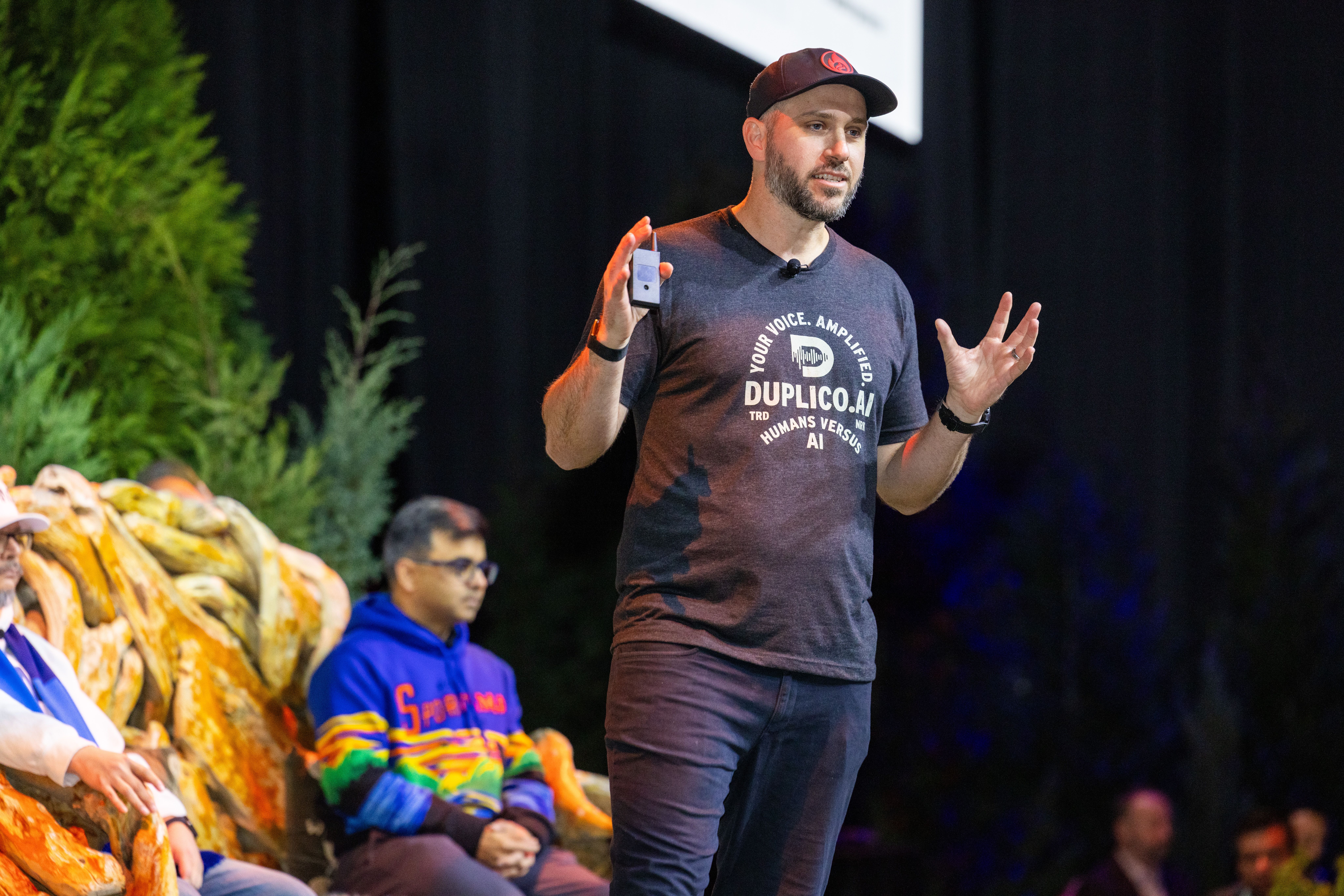
How to Make AI Actually Sound Like You (The Voice-First Method)
You've tried the prompts. You've copied the frameworks. You told ChatGPT to "write in a professional but friendly tone."
And it still sounds like everyone else.
You know exactly what I mean. That overly polished, weirdly smooth, sounds-like-a-LinkedIn-robot-wrote-it content that floods every feed right now. You read it and think, "This is fine, I guess." But you'd never share it. You'd never save it. And you definitely wouldn't remember who posted it.
Here's the thing. Making AI content sound like you isn't a prompt problem. It's an input problem. And almost everyone is solving the wrong one.
I've spent the last two years building a voice-first AI content platform called Duplico, coaching 175+ mortgage professionals on how to use AI for content, and speaking at conferences like MortgageCon and AIME Fuse about this exact topic. The method I'm about to walk you through is the same one that helped a loan officer named Paul Byron generate 2.4 million views and close a $699,000 loan from a single piece of content.
It works. But it requires you to stop thinking about AI as a writing tool and start thinking about it as a cloning tool.
Why "Write in My Tone" Doesn't Work
Here's what most people do. They open ChatGPT, type something like "write a LinkedIn post about mortgage rates in a conversational, authoritative tone," and hit enter.
The output is fine. It's grammatically correct. It hits the right notes. But it sounds like every other AI-generated post on the platform.
Why?
Because you gave AI a vibe, not a voice.
Telling AI to be "conversational and authoritative" is like walking into a restaurant and saying "make me something good." Sure, the chef can cook. But you're getting the house special, not your favorite meal.
Everyone is ordering the same thing. "Professional but approachable." "Friendly but knowledgeable." "Casual but credible."
Those aren't differentiators. Those are the default settings. You just described the factory preset that every AI model already defaults to.
And here's why that matters more than you think. These models are probability machines. They're predicting the most likely next word based on everything they were trained on. When you give vague instructions, you get the statistical average of all the content on the internet.
That's not your voice. That's everybody's voice blended together.
The Voice-First Method: 3 Steps to AI Content That Actually Sounds Like You
Most people try to fix their AI output after it comes out wrong. They tweak the prompt. They edit the draft. They run it through a "humanizer" tool that just rearranges the same generic words.
The Voice-First Method flips it. Instead of fixing output, you fix input. You teach AI how you actually communicate before it writes a single word.
There are three steps. I'll walk you through each one.
Step 1: The Voice Interview
This is the foundation of everything. And it's the step almost nobody does.
A Voice Interview is exactly what it sounds like. You talk. Out loud. About your business, your opinions, your experiences, your stories. And you record it.
Not a script. Not bullet points you prepared the night before. You literally just talk the way you'd talk to a friend over coffee.
Why does this matter? Because the way you write and the way you talk are two completely different things. When you sit down to write, you tighten up. You get formal. You start using words you'd never actually say. But when you're talking to someone – really talking, not presenting – your real voice comes through.
The dropped apostrophes. The half-finished thoughts. The way you circle back to a point after going on a tangent. The phrases you repeat without realizing it. The analogies that come naturally to you.
That's your Voice DNA. And that's what AI needs to clone you accurately.
Here's the process: Record yourself talking about your work for 20 to 30 minutes. Answer questions like "What's your biggest frustration with your industry?" and "Tell me about a client you helped recently" and "What do you wish people understood about what you do?" Don't prep. Don't rehearse. Just talk.
Then feed that transcript to your AI tool. Not as a prompt – as context. As training material. You're telling the AI, "This is how I actually communicate. Learn it."
I've done this with hundreds of professionals. The difference in output quality between someone who did a Voice Interview and someone who just told AI to "sound like them" is massive. It's not even close.
Step 2: Feed AI Your Voice DNA (Not a Style Guide)
Once you've done the Voice Interview, you have raw material. But raw material needs to be organized.
Voice DNA is the specific, tangible elements of how you communicate. It's not "professional but friendly." It's stuff like:
- You start stories with "So here's the thing."
- You use food analogies more than sports analogies.
- You say "right?" at the end of sentences when you're making a point.
- You curse occasionally but only for emphasis.
- You use short, punchy sentences when you're fired up and longer ones when you're explaining something complex.
Those details are what make AI output sound like a specific person instead of a generic content bot.
A style guide says "use a conversational tone." Voice DNA says "this person drops the g on -ing words, starts paragraphs with 'Look,' and always uses a real example before explaining a concept."
One gives AI a direction. The other gives AI a destination.
When I built Duplico, this was the core insight that changed everything. We don't ask people to describe their voice. We capture it. There's a massive difference between someone telling you what they sound like and actually hearing them speak.
Think about it this way. If someone asked you to describe how your best friend talks, you'd struggle. But if they played you ten audio clips, you'd pick your friend out instantly. AI works the same way. It needs samples, not summaries.
Feed your AI tool transcripts of how you actually talk. Give it examples of content you've written that felt like "you." Show it posts that got engagement because they were authentic, not because they were polished. And tell it what you never say. The words that would make you cringe if they showed up in your content. I call these your Banned Words. I published a full list with examples in Why 90% of AI Content Is Garbage.
For my stuff, that list includes words like "leverage," "unlock," "game-changer," "revolutionary," and any sentence that starts with "In today's…" You know the words. You've seen them a thousand times. They're the reason everyone's AI content sounds identical.
Step 3: The Bar Test
This is the quality check that keeps everything honest.
Read your AI-generated content out loud. Then ask yourself: Would I actually say this to someone at a bar?
Not at a conference. Not in a webinar. At a bar. Talking to a friend or a colleague over a drink.
If the answer is no, it's not your voice yet.
The Bar Test catches the stuff that looks fine on screen but sounds wrong when spoken. The triple parallel structures. The perfectly balanced sentences. The transitions that are a little too smooth. Real people don't talk in perfectly structured paragraphs. They ramble. They repeat themselves. They say "right?" and "you know?" and "look" and "here's the thing."
AI loves to clean all of that up. It loves symmetry and polish. That's exactly why you need to check it.
When I'm reviewing content for our members, the Bar Test is the first thing I run. I'll read a paragraph and think, "Would this person actually say 'harness the power of authentic storytelling'?" No. They'd say something like, "Tell a real story. People connect with that."
Same idea. Completely different voice.
What Happens When You Get This Right
I told you about Paul Byron at the top. Let me give you the full story because it matters.
Paul is a loan officer. He'd been posting content for a while, doing what most LOs do – rate updates, market commentary, the usual stuff. It was fine. It got a few likes from the same people every time.
He went through the Voice-First Method. Did the interview. Built his Voice DNA profile. Started creating content that sounded like him instead of sounding like "loan officer content."
One post hit 2.4 million views. He closed a $699,000 loan directly from it. From one post.
But Paul isn't the only one.
Gustavo booked 8 appointments from a single post. Joanna saw her engagement jump 230% in her first week and pulled 22 comments in 8 hours on a post that would've gotten a like or two before. Tony doubled his reach to 100,000 in 28 days. Glenn generated a lead from his very first piece of voice-matched content. Travis got 3 real estate agents to share his content the first time he used the method.
Nate, one of our members, started getting results so fast he called it "VooDoo." J.R. Conway came to us six months ago knowing nothing about AI. Now he's teaching other people how to use it.
None of these people are professional content creators. They're loan officers. They close loans for a living. But their content performs because it sounds like them – not like a chatbot.
The Bigger Picture Most People Miss
Here's the bigger picture that most people miss.
AI tools are only getting better. The writing quality, the speed, the capabilities – all of it improves every few months. Which means everyone will have access to the same level of AI output. The playing field is leveling.
So when everybody has access to the same tools, what makes you different?
Your humanness is your moat.
Your stories. Your opinions. Your specific way of explaining things. The fact that you've been in your industry for 10 or 15 or 20 years and you've seen things that a language model never will.
AI can write. It can write well. But it can't be you unless you teach it to be.
The people who figure this out early are going to have a massive advantage. Once you have your voice dialed in, you can create a full month of content in about an hour. Because while everyone else is posting the same AI-polished content that all blurs together, they'll be the ones whose content actually stops the scroll.
Because it sounds real. Because it sounds like a person. Because it sounds like them.
Frequently Asked Questions
Can AI really learn to write in my specific voice?
Yes, but only if you give it the right inputs. Telling AI to 'be conversational' gives you generic output. Feeding it a 30-minute transcript of how you actually talk gives it your real speech patterns, word choices, and personality. The quality of the input determines the quality of the output. Always.
How long does it take to set up the Voice-First Method?
The Voice Interview itself takes about 20 to 30 minutes. Building your Voice DNA profile from the transcript takes maybe another hour. After that initial setup, every piece of content you create benefits from it. Most people see a noticeable difference in their very first post after doing the interview.
Do I need special AI tools for this, or can I use ChatGPT?
You can apply this method with any AI tool. ChatGPT, Claude, Gemini - they all benefit from better input. That said, I built Duplico specifically to automate the Voice Interview and Voice DNA capture process because doing it manually in ChatGPT requires a lot of setup every time. The method works regardless. The platform just makes it faster.
What if I'm not good on camera or don't have a strong personal brand yet?
The Voice-First Method isn't about being a content creator. It's about communicating like yourself. You don't need to be charismatic or polished. You just need to talk like you talk. Some of our best-performing members are people who'd never describe themselves as 'good at content.' They just sound real, and that stands out right now.
How is this different from the "humanizer" tools I see everywhere?
Humanizer tools take generic AI content and try to make it sound less robotic. They're fixing a symptom. The Voice-First Method fixes the cause. Instead of polishing bad output, you give AI better input from the start. The content comes out sounding like you on the first draft, not after running it through three tools to try to undo the damage.
I'm a loan officer. Does this actually work for mortgage content specifically?
It works especially well for mortgage professionals because the industry is flooded with identical AI content right now. Rate updates that all sound the same. Market commentary that could've been written by anyone. When your content actually sounds like a real person with real opinions and real experience, you stand out immediately. That's how Paul Byron's post hit 2.4 million views in a market full of generic content.
Written by
Luke Shankula
Luke Shankula is the founder and CEO of Direct Authority AI, a comprehensive AI-powered platform and coaching community helping mortgage professionals build scalable, agent-independent businesses through AI automation and direct-to-consumer marketing. Based in San Diego, Luke leads a community of 175+ loan officers who are leveraging AI for competitive advantage. He created Duplico, Direct Authority AI's flagship software featuring 50+ AI marketing tools that generate authentic, on-brand content across multiple platforms - from social media and email sequences to video scripts and webinar presentations. Luke has become a sought-after speaker on AI implementation in mortgage, presenting at major industry events including MortgageCon, AIME Fuse, IMN Mortgage AI Conference, and the HMA Sales Rally. His monthly AI Summit attracts 600+ registrants, making it one of the mortgage industry's premier AI education events. His work has been featured in National Mortgage News, NBC, Yahoo Finance, Mortgage Marketing Animals podcast, and The Loan Officer Podcast. Above all, Luke is a husband, father of four, and passionate entrepreneur focused on helping mortgage professionals build businesses they're proud of while staying ahead of technological change in their industry.
Want more insights like this?
I share AI strategies, mortgage marketing tips, and business lessons regularly.