The Voice-First AI Guide: How to Make AI Content Sound Human
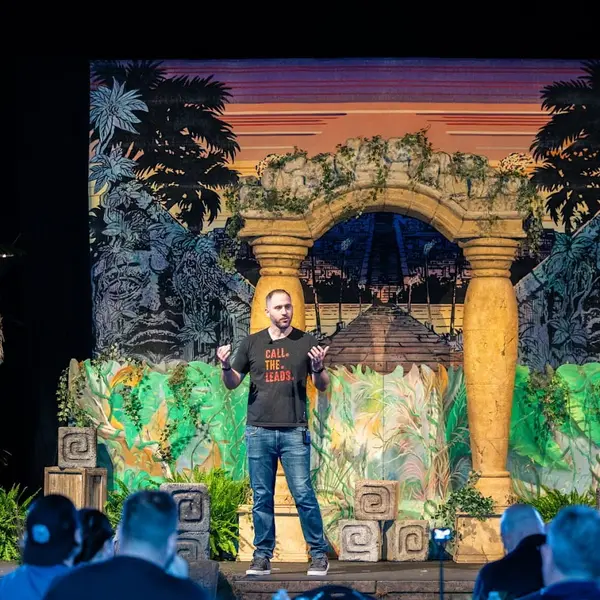 Luke Shankula
You make AI content sound human by feeding it your voice before you ask it to write. That is the entire concept in one sentence. Most people do it backwards. They type a prompt, get robotic output, then spend 45 minutes trying to edit it into something that sounds like them. The fix is reversing that order: capture your voice first, then let AI amplify it.
I have watched hundreds of business owners, marketers, and creators go through this exact struggle. They sign up for ChatGPT or Claude or whatever tool is trending this month. They type in a prompt. And what comes back reads like it was written by a committee of middle managers who all went to the same corporate communications seminar.
You know exactly what I mean. The "in today's fast-paced digital world" openings. The perfectly structured five-paragraph essays that say nothing specific. The content that technically answers the question but sounds like it could have been written by literally anyone on the planet.
That is the problem. And it is fixable. But you have to understand why it happens before you can stop it.
Why Does AI Content Sound So Generic?
AI writes like the average of the internet. That is what it was trained on. Millions of blog posts, articles, and pages that all sound roughly the same because they were all written to rank, not to resonate.
Think of it like a restaurant. If you asked a chef to make the "average meal" based on every recipe ever written, you would get something technically edible but completely forgettable. No spice. No personality. No reason to come back. That is what AI does with your content when you give it a generic prompt.
The problem is not the AI. The AI is doing exactly what you asked it to do. You said "write a blog post about marketing." So it wrote the average blog post about marketing. You did not give it anything specific to work with. No stories. No opinions. No experiences. No voice.
This is what most people miss. AI is a magnifier. If you feed it nothing, it magnifies nothing. If you feed it your actual voice, your real opinions, your specific experiences, it magnifies those. The output matches the input. Every single time.
I learned this the hard way. When I first started using AI for content, everything it produced sounded like a textbook. Technically correct, completely lifeless. I kept tweaking prompts and adding instructions like "write in a conversational tone" and "be casual." It did not work. The AI's version of "casual" was still corporate. Its version of "conversational" was still stiff.
Then I tried something different. Instead of telling AI how to write, I showed it. I recorded myself talking about the topic for ten minutes. Unscripted. Just me explaining it the way I would explain it to a friend. I fed that transcript to the AI and said "write a blog post in this voice about this topic." The difference was massive.
That was the moment I realized the whole approach was wrong. And it is the reason I eventually built Duplico as a voice-first AI content platform - because this problem needed a systematic fix, not a better prompt.
The Voice-First Method: 3 Steps to Human-Sounding AI Content
Step 1: Capture Your Voice DNA Before You Write Anything
Your voice has patterns. The way you start sentences. The words you reach for. The length of your thoughts. The things you emphasize and the things you skip. These patterns are your Voice DNA, and they are what make your content sound like you instead of like everyone else.
Here is how to capture it. Record yourself talking about your area of expertise for 10 to 30 minutes. Do not script it. Do not outline it. Just talk. Explain something you know well to an imaginary friend who is smart but knows nothing about your field.
Then transcribe that recording and look at what shows up:
- Your natural sentence length. Some people think in short bursts. Others explain in longer threads. Neither is wrong. Both are you.
- Your go-to transitions. Do you say "so here's the thing" or "let me break this down" or "the way I think about it"? Those phrases are yours. Keep them.
- Your opinion patterns. Do you lead with what you believe or build to it? Do you state things as facts or frame them as observations? This matters more than you think.
- Your proof style. Do you tell stories or cite numbers? Do you reference people by name or describe situations? Your proof style is part of your voice.
Once you have this captured, you have something AI can actually work with. You are not asking it to guess what "conversational" means to you. You are showing it.
I have trained over 200 members inside my coaching community on this exact process. The ones who skip this step produce generic content. The ones who do it produce content that their audience actually recognizes as theirs. There is no shortcut around it.
Step 2: Build Your Banned Words List
This is the fastest fix for AI slop. Every AI model has words it defaults to. Words that no actual human uses in real conversation. Words that immediately signal to your reader that a robot wrote this.
Here are some of the worst offenders: leverage, unlock, revolutionize, empower, synergy, cutting-edge, game-changer, utilize, robust, paradigm, holistic, scalable, deep dive, unpack, delve.
Read that list out loud. Would you say any of those words to a friend over coffee? Probably not. But AI uses them constantly because they appear all over the internet in exactly the kind of generic content AI was trained on.
Build a list. Tell your AI tool: never use these words. Give it alternatives. "Leverage" becomes "use." "Utilize" becomes "use." (Yes, both of them just mean "use." English already had the word.) "Deep dive" becomes "break down." "Cutting-edge" becomes "new."
I keep a running banned words list that I update monthly. It started with about 15 words. It is over 20 now. Every time I see a word in AI output that makes me cringe, it goes on the list. This single practice has done more for my content quality than any prompt engineering trick I have ever tried.
The Banned Words Test is dead simple: if you would not say it to someone sitting across from you at a bar, cut it. If it sounds like something a press release would say, cut it. If you read it and hear a robot voice in your head, cut it.
If you want a starting point, I put together a full breakdown of why most AI content fails and what to do about it. That post covers the specific patterns that make content sound artificial and how to systematically remove them.
Step 3: Run the Bar Test on Everything
The Bar Test is the final filter. Before you publish anything, read it out loud and ask yourself one question: would I actually say this to another person at a bar?
Not on a stage. Not in a boardroom. Not in a keynote speech. At a bar. To a real person. Over a drink.
If the answer is no, rewrite it.
This sounds simple. It is simple. But it catches things that no other editing process catches. It catches sentences that are technically correct but emotionally flat. It catches paragraphs that explain without teaching. It catches content that informs without connecting.
The Bar Test works because it forces you to hear your content as conversation. And conversation is what people actually respond to. Nobody shares a blog post because it was well-structured. People share content because it made them feel something. Because it said something they were thinking but could not articulate. Because it sounded like a real person with a real opinion.
I wrote a whole piece on how to make AI sound like you that goes deeper on this process. The short version: your voice is your competitive advantage, and it is the one thing AI cannot replicate on its own. But it can amplify it if you give it the right inputs.
What Happens When You Get This Right
Let me tell you about Paul Byron. Paul is a loan officer who started using these frameworks to create content. One post. A single story post on social media about a client experience, written the way he would actually tell the story to a friend.
That post got 2.4 million views. A real estate agent saw it, reached out, and referred a client. Paul closed a $699K loan from that one piece of content. Not because the post was optimized or viral-bait or anything fancy. Because it sounded like a real person with a real story.
Or look at Gustavo. He made a single post using a voice-first framework. One post. He got 8 appointments and a 300% increase in reach. No ads. No cold outreach. Just content that resonated because it sounded like him.
Joanna Perry spent $75,000 over 17 years on developers and coaches trying to get her online presence right. She joined our community, learned the voice-first approach, built her own website in one week, and saw a 230% increase in engagement.
Dan Flavin is getting leads directly from social media using Duplico to create his content. Not because the tool is magic, but because the tool starts with a voice interview. It captures how Dan actually talks before it produces anything. The content works because it sounds like Dan, not like a content mill.
These are not outliers. They are the pattern. When you put your voice first, the content works. When you skip that step and go straight to prompting, it does not.
The Voice-First Framework for Any Platform
This method works everywhere. Blogs, social posts, emails, video scripts, website copy. The platform changes. The process does not.
For Blog Posts
Record yourself explaining the topic for 5 to 10 minutes. Transcribe it. Feed the transcript to your AI tool along with your Voice DNA document and your banned words list. Ask it to write the post in your voice using the ideas from the transcript.
Then edit. Not for grammar. For voice. Read every sentence and ask: is this me? Would I say this? Does this sound like something I would write at 10pm when I actually have something to say?
For Social Posts
Take one idea from a longer piece of content and record yourself explaining just that one idea in 60 seconds. Transcribe. Feed it to AI. The constraint of one idea forces specificity, which is what makes social content work.
For Emails
Emails are the most personal format. Start by typing the first two sentences yourself. Where are you right now? What are you doing? What just happened? Then let AI continue in your voice. The personal opening grounds the whole email.
For Video Scripts
Record the rough version first. Just you talking through the content. Then use AI to tighten it, cut the filler, and add structure while keeping your pacing and your phrases.
The consistent thing across all of these: you talk first, AI writes second. You can even create a full month of content in about an hour once you have this system dialed in. The voice capture is the bottleneck, and it takes 10 to 30 minutes. Everything after that is amplification.
Why Voice-First Is the Only Sustainable AI Content Strategy
Here is where I get a little philosophical. And I think this matters more than the tactical stuff.
AI is going to keep getting better. The writing will get smoother. The grammar will get cleaner. The structure will get tighter. Within a year or two, AI will produce technically perfect content on any topic you can name.
And that is exactly why voice matters more than ever. When everyone has access to the same tools producing the same level of quality, the only thing that separates your content from the next person's content is you. Your experiences. Your opinions. Your stories. Your way of seeing the world.
Your humanness is your moat. It is the only thing AI cannot generate on its own. It can mimic a voice if you show it one. But it cannot invent a genuine perspective. It cannot create a real story from lived experience. It cannot form an authentic opinion based on years of doing the work.
The people who figure this out early are going to win. The people who keep using AI as a content slot machine, pulling the lever and hoping something good comes out, are going to drown in a sea of average content that all sounds exactly the same.
For the loan officer-specific version of this content playbook, see directauthorityai.com/blog/ai-content-for-loan-officers-guide.
Frequently Asked Questions
How long does it take to capture your voice for AI?
The initial voice capture takes 10 to 30 minutes. You record yourself talking about your expertise, transcribe it, and identify your patterns. After that, your Voice DNA document is reusable for every piece of content you create.
Can AI really replicate a person's writing voice?
AI can match your patterns, your word choices, and your sentence structure if you give it enough examples. It cannot invent your opinions or your experiences. That is why voice-first works: you provide the substance, AI handles the scaling.
What is the biggest mistake people make with AI content?
Going straight to prompting without any voice input. They type "write a blog post about X" and wonder why it sounds generic. The AI has nothing personal to work with, so it defaults to the average of everything it has seen.
Does the voice-first method work for businesses, not just personal brands?
Yes. Every business has a voice, even if it has not been documented. The same process applies: record key people in the company talking about what they do and why it matters. Transcribe. Extract the patterns. Feed those to AI.
How do I know if my AI content actually sounds human?
Read it out loud. If you stumble, the sentence is too complex. If you cringe, the word choice is wrong. If you would not say it to someone sitting across from you, rewrite it. This is the Bar Test.
What tools do I need to start the voice-first method?
A phone to record yourself, a transcription service, and any AI writing tool. That is it. The method is tool-agnostic. The technology is not the hard part. Committing to the voice-first habit is the hard part.
Is voice-first content better for SEO?
Yes, because search engines are increasingly rewarding content that demonstrates real expertise and experience. When your content sounds like it came from a person who actually does this work, it signals authenticity in a way that generic AI content cannot.
Where to Go From Here
If you made it this far, you already know more about making AI content sound human than most people who have been using these tools for months. The framework is simple: capture your voice, build your banned words list, and run the Bar Test on everything.
Most people will read this, nod along, and then go back to typing prompts into ChatGPT without any voice input. A few will take the 15 minutes to record themselves talking and see the difference immediately. Those are the ones whose content starts working.
If you want to see more about how I think about AI content and building systems that actually work, follow me on social @lshankula. And if you are interested in the voice-first platform I built to make this whole process faster, check out Duplico on the Direct Authority AI site.
Frequently Asked Questions
How long does it take to capture your voice for AI?
The initial voice capture takes 10 to 30 minutes. You record yourself talking about your expertise, transcribe it, and identify your patterns. After that, your Voice DNA document is reusable for every piece of content you create.
Can AI really replicate a person's writing voice?
AI can match your patterns, your word choices, and your sentence structure if you give it enough examples. It cannot invent your opinions or your experiences. That is why voice-first works: you provide the substance, AI handles the scaling.
What is the biggest mistake people make with AI content?
The biggest mistake is going straight to prompting without any voice input. People type "write a blog post about X" and wonder why it sounds generic. The AI has nothing personal to work with, so it defaults to the average of everything it has seen.
Does the voice-first method work for businesses as well as personal brands?
Yes. Every business has a voice, even if it has not been documented. The same process applies: record key people in the company talking about what they do and why it matters, transcribe those conversations, extract the patterns, and feed them to AI.
How do I know if my AI content actually sounds human?
Use the Bar Test: read the content out loud and ask if you would actually say it to someone sitting across from you. If you stumble, the sentence is too complex. If you cringe, the word choice is wrong. If you would not say it in conversation, rewrite it.
What tools do I need to start using the voice-first method?
You only need a phone to record yourself, a transcription service, and any AI writing tool. The method is tool-agnostic. The hard part is committing to the habit of talking first and prompting second.
Is voice-first AI content better for SEO?
Yes. Search engines are increasingly rewarding content that demonstrates real expertise and experience. When your content sounds like it came from a person who actually does the work, it signals authenticity in a way generic AI content cannot.
Want more insights like this?
I share AI strategies, mortgage marketing tips, and business lessons regularly.